March 2, 2026

Apology Text to My Wife After I Yelled – 3 Real Versions That Help Apology Text to My Wife After I Yelled: 3 Versions That Actually […]



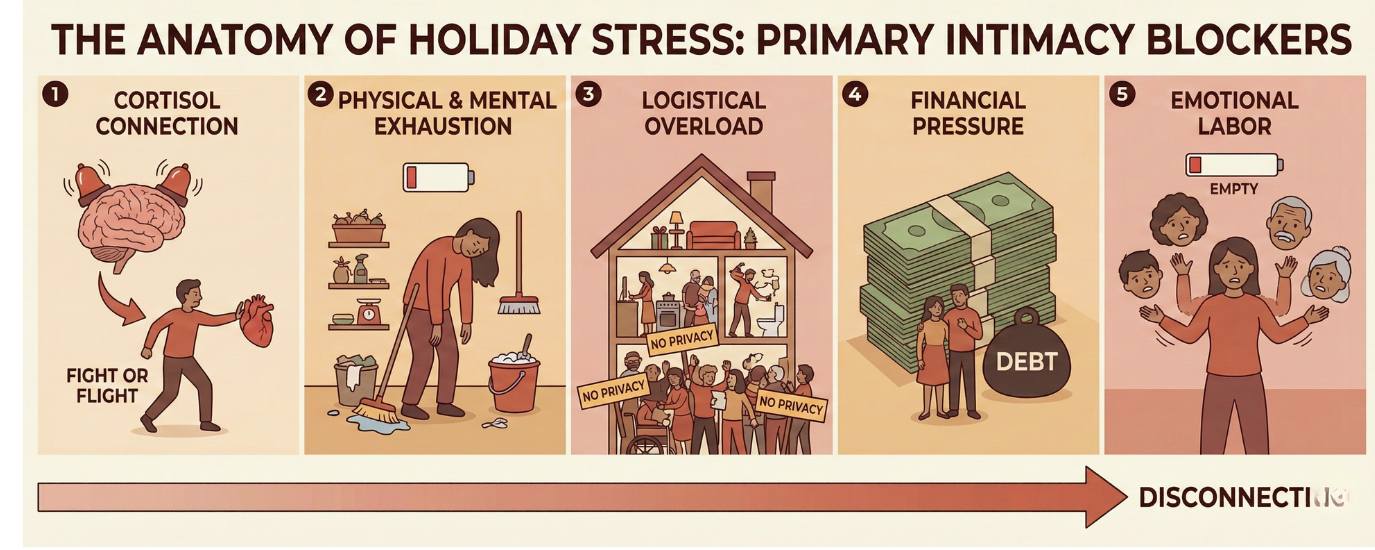
The house smells like pine and gingerbread, the lights on the tree are twinkling, and your calendar is a chaotic mess of parties and obligations. You look over at your partner, who is frantically wrapping a last-minute gift, and you feel… nothing. Or worse, you feel a wave of irritation. The silence between you two has grown louder than any Christmas carol. If this sounds painfully familiar, I want you to take a deep breath. You are not broken, and your relationship is not doomed. You’ve just run headfirst into the holiday intimacy blockers.
It's a strange and lonely feeling, isn't it? Society screams at you to be merry, joyful, and connected, but your reality is a marathon of errands, tight budgets, and navigating tricky family dynamics. You collapse into bed at night, and sex feels less like a passionate release and more like another item on an impossible to-do list. So, you don't. And the distance grows.
Let’s cut to the chase. This isn't just in your head; it’s a physiological and emotional response to an overwhelming season. Your body is jacked up on cortisol—the stress hormone—which is basically the kryptonite of libido. The vicious cycle of holiday stress and low libido is a real phenomenon that leaves you feeling touched-out, exhausted, and completely out of sync with your partner. Your conversations become purely logistical, and the crucial task of maintaining emotional connection with spouse gets buried under piles of wrapping paper and receipts. You stop being partners and start being co-workers in the chaotic business of "making the holidays happen."
So what can you do when you're running on empty? The truth is, that maintaining emotional connection with spouse is the absolute bedrock of physical intimacy, and right now, that foundation is getting rocked. The constant pressure creates a climate where even a simple touch can feel like a demand. This isn't just about finding 30 free minutes; it's about tearing down the invisible wall that stress has built between you brick by brick. The combination of holiday stress and low libido doesn't have to be your story this year.
But here’s the good news. I’m not going to just leave you there. This article is your practical, step-by-step game plan. We are going to break down exactly what these intimacy blockers are—the financial strain, the exhaustion, the family drama—and give you a powerful toolkit to fight back. My goal is to give you a clear, actionable roadmap for how to reconnect with your partner during the holidays. We'll move beyond the generic "plan a date night" advice and get into real strategies that work even when you're surrounded by chaos and in-laws. Ready to reclaim your connection? Let's get started.
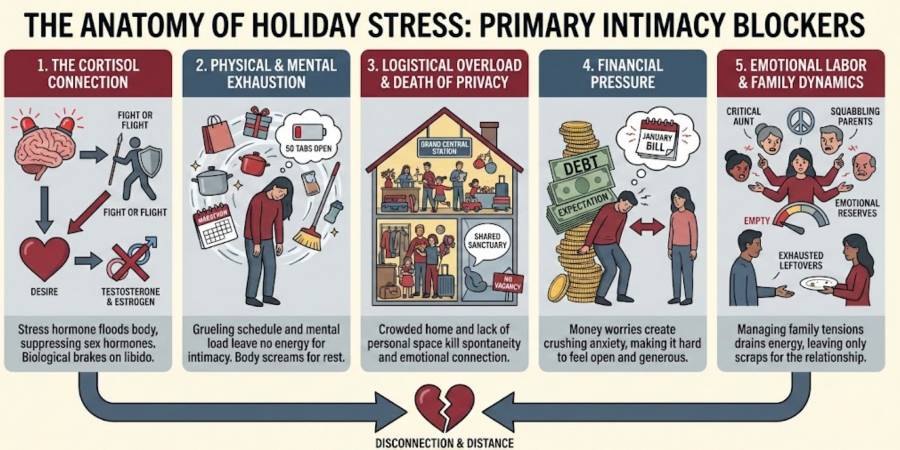
So, let's get under the hood of this thing. Why does a season that’s supposed to be about connection so often create a canyon between you and your partner? It's not a moral failing; it's biology and logistics conspiring against you. We’re talking about real, tangible forces that I call “intimacy blockers.”
First, let's talk about your brain on stress. When you're juggling a budget, a burnt batch of cookies, and your mother-in-law’s passive-aggressive comments, your body floods with a hormone called cortisol. Think of it as your internal alarm system, designed to help you either fight a saber-toothed tiger or run from it. It's incredibly useful for survival.
The problem? It’s absolutely terrible for your sex life. Your body can't be in "fight or flight" mode and "rest and connect" mode at the same time. According to a landmark study in the Journal of Sexual Medicine, elevated cortisol is directly linked to lower sexual arousal in women. In both men and women, it actively suppresses the very sex hormones—testosterone and estrogen—that fuel desire. You're not just "not in the mood"; your body has biologically hit the brakes.
Now, add pure, unfiltered exhaustion to that hormonal cocktail. The holiday season isn't a sprint; it's a grueling, month-long marathon of shopping, wrapping, cooking, cleaning, and traveling. You're sleep-deprived and mentally fried. The American Psychological Association consistently finds that holiday stress is a major issue, with a 2021 poll showing 38% of people feel their stress levels spike this time of year.
When your brain has 50 tabs open—from tracking packages to remembering who’s allergic to nuts—there is simply no bandwidth left for seduction. Your mind and body are screaming for one thing: rest. Intimacy requires a certain amount of mental and physical energy that, right now, you just don't have in the tank.
Your home, which is normally your shared sanctuary, suddenly becomes Grand Central Station. The guest room is occupied, the kids are on a sugar high and out of school, and your personal space has shrunk to virtually nothing. Where exactly is the spontaneity supposed to happen? Between your cousin sleeping on the air mattress in the living room and the kids waking up at dawn to check for presents?
This complete logistical takeover kills privacy, which is the soil in which intimacy grows. You lose the quiet moments, the lazy mornings in bed, and the freedom to walk around in your underwear. Without that physical space to be yourselves, the emotional space starts to close up, too.
Let's not forget the giant elephant in the room: money. The pressure to buy the perfect gifts, host a lavish dinner, and travel to see family can create a crushing weight of financial anxiety. This isn't just a background hum of worry; it's a primary stressor that keeps you up at night.
This financial strain often goes unspoken, simmering as resentment or fear. It’s hard to feel open, generous, and connected with your partner when you're secretly panicking about the January credit card bill. That preoccupation is a powerful intimacy killer.
Finally, there’s the emotional minefield of family. You're not just hosting people; you're managing personalities, navigating decades-old tensions, and performing emotional gymnastics to keep the peace. All that energy you spend placating your critical aunt or mediating a squabble between your parents is energy that's being siphoned away from your relationship.
By the end of the day, your emotional reserves are completely drained. The person you want to connect with most is the one who gets the exhausted, empty leftovers of you. It’s a recipe for disconnection.
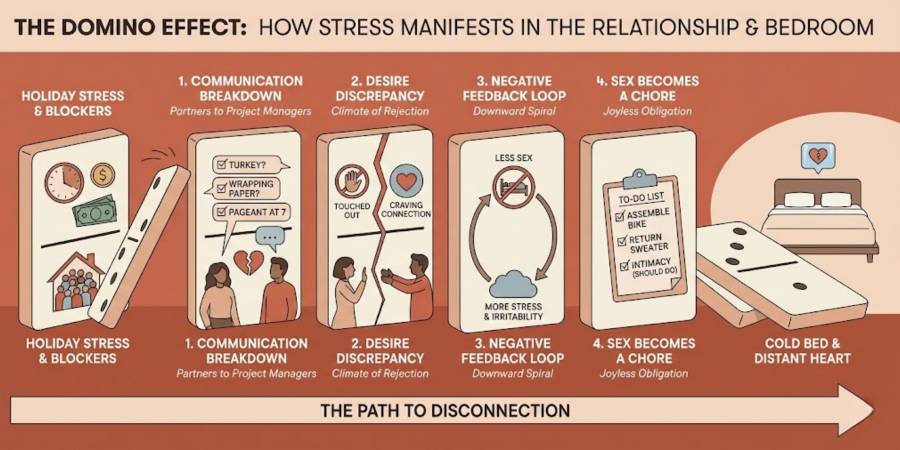
These blockers don't just exist in a vacuum. They set off a chain reaction, a series of dominoes that fall one by one, leading straight to a cold bed and a distant heart. You might not even notice it happening at first, but the signs are always there.
Listen to your conversations. Have they shifted from sharing dreams and feelings to just running down a checklist? "Did you pick up the turkey?" "Don't forget the school pageant is at 7." "We need more wrapping paper." You stop being lovers and become co-managers of the holiday project.
This transactional communication starves your relationship of the emotional oxygen it needs. Without that daily diet of real, vulnerable conversation, you start to feel like roommates. And let's be honest, nobody wants to have sex with their roommate.
Here’s a painful truth: stress doesn't affect everyone's libido the same way. For one of you, the exhaustion and feeling of being constantly needed might make you feel completely "touched out." The last thing you want is one more person needing something from you.
But for the other partner, sex might be the very thing they crave for connection and stress relief. This mismatch is brutal. It creates a painful cycle where one person initiates and feels rejected, and the other feels pressured and misunderstood. This is where the combination of holiday stress and low libido can create deep, lasting wounds if you don't address it head-on.
This is where the downward spiral really picks up speed. When you're not connecting physically, the small annoyances start to feel like huge problems. You become more irritable and less patient with each other. That lack of intimacy breeds more stress, which in turn kills your libido even more.
You get stuck. The less sex you have, the more stressed you feel; the more stressed you feel, the less sex you have. It’s a self-perpetuating cycle that can make you feel hopeless, and it underscores why maintaining emotional connection with spouse is not a luxury, but a necessity to break the loop.
Amidst the mountain of holiday tasks, sex can start to feel like just another obligation. It gets mentally filed alongside "assemble the bicycle" and "return the ugly sweater." When that psychological shift happens, all the joy, playfulness, and pleasure are stripped away.
Intimacy becomes something you feel you should do rather than something you want to do. And because you're already exhausted, it becomes the easiest "chore" to postpone indefinitely.
Okay, enough with the doom and gloom. Recognizing the problem is half the battle, but the other half is having a game plan. You can’t stop the holidays from coming, but you can absolutely change how you navigate them—together.
Before the first guest arrives or the first dollar is spent, you need to sit down and have a real strategy session. This isn't a fight; it's a huddle. Set a firm, realistic budget you both agree on. Decide which parties you genuinely want to attend and which ones you can politely decline.
Most importantly, divide the labor equitably. Who is handling the cards? Who is in charge of the outdoor lights? Getting aligned before the chaos hits prevents the resentment that builds when one person feels like they're doing it all.
You have to consciously give yourselves—and each other—permission for the holidays to be imperfect. The goal is not a spread worthy of a magazine cover; the goal is connection. So, what if you order a pre-cooked turkey? So, what if the gifts are in bags instead of perfectly wrapped boxes?
Let go of the external pressure. Your relationship's health is infinitely more important than impressing your relatives. Prioritize what truly matters: your sanity and your bond.
This is non-negotiable. Commit to just 10 minutes every single day where no logistics are allowed. No talking about schedules, budgets, or travel plans. The only agenda item is to look each other in the eye and ask, "How are you doing today? Really."
Then, just listen. Don't try to solve anything. This tiny ritual is a powerful anchor that ensures you see the human being behind the holiday machine. This is the absolute key to maintaining emotional connection with spouse when everything else is pulling you apart.
Alright, it's game time. The season is in full swing, and you need some practical, in-the-moment tools to keep that fire from going out completely. These are your go-to plays when you feel the distance creeping in.
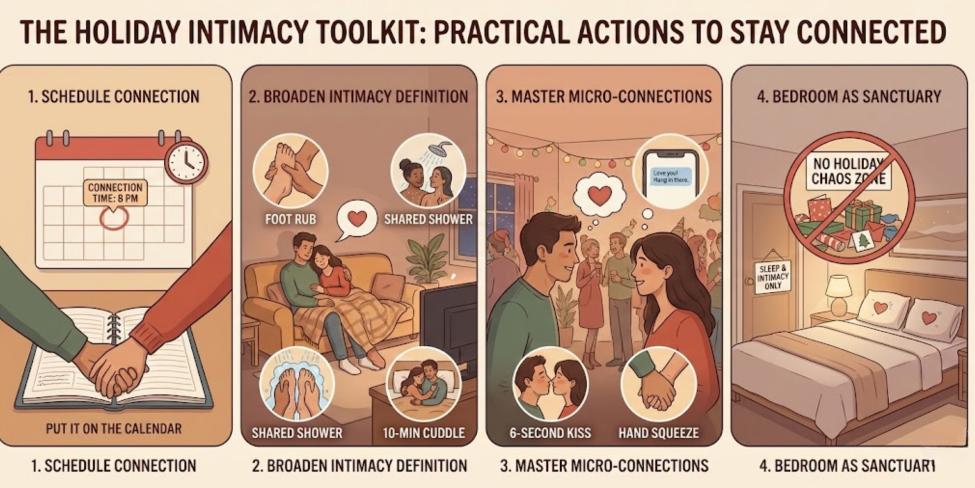
I know, "scheduling sex" sounds deeply unromantic. Get over it. During chaotic times, spontaneity is a myth. Intention is the new sexy. If you don't put it on the calendar—whether it's a 20-minute window for a quickie or a full-on date night—it will not happen.
Putting it on the calendar gives it importance. It tells your partner, "You are a priority." It also builds anticipation, which is a powerful aphrodisiac all on its own.
Sometimes, intercourse just isn't in the cards. You’re too tired, too stressed, or you have a house full of people. That's okay! The path for how to reconnect with your partner during the holidays isn't just about sex; it’s about connection.
Focus on other forms of intimacy. Take a shower together at the end of a long day. Give each other a foot rub while you watch TV. Cuddle for 10 minutes before falling asleep. These acts fill up your intimacy bank account and keep you bonded, even without the grand finale. The persistent challenge of holiday stress and low libido often requires this broader, more patient approach.
You can maintain a powerful current of connection with tiny, consistent gestures throughout the day. These are the things that take less than 30 seconds but say, "I see you, I love you, we're in this together."
Try the 6-second kiss—long enough to actually feel something. Send a flirty or appreciative text in the middle of a crazy day. Catch their eye across a crowded room at a party and share a private smile. Squeeze their hand when you're navigating a crowded mall. These micro-connections are the glue that holds you together. This is how to reconnect with your partner during the holidays in a way that feels manageable and real.
This is a simple but powerful rule: the bedroom is a "holiday-free zone." No wrapping presents on the bed. No addressing holiday cards while propped up on the pillows. And absolutely no stressful conversations about money or family logistics.
Your bedroom should be reserved for two things only: sleep and intimacy. Protect that space fiercely. When you cross the threshold, you leave the chaos of the holidays behind you. This physical boundary creates a mental one, signaling to your brains that this is a place for rest and connection.
The holiday season's intense demands—spanning finances, family dynamics, and logistics—can severely undermine a couple's intimacy by triggering a physiological stress response. Elevated cortisol levels directly suppress sex hormones, while physical and mental exhaustion leave no energy for connection. This stress manifests as communication breakdowns, mismatched libidos, and a negative feedback loop where less sex creates more tension.
To counteract this, couples should proactively align on expectations, budgets, and boundaries before the season begins. The solution lies in shifting from a "perfect holiday" mindset to one prioritizing the relationship. Intentional strategies, such as scheduling connection, expanding the definition of intimacy beyond intercourse, using small daily gestures to maintain a bond, and protecting the bedroom as a stress-free sanctuary, are crucial for staying connected amid the chaos.
The loss of privacy is a significant logistical hurdle that directly impacts a couple's ability to connect. When your home feels like a public space, spontaneity vanishes. The key is to shift your strategy from seeking large windows of time to creating intentional, smaller moments of connection. This can involve scheduling a 20-minute "no interruptions" block where you retreat to the bedroom, even if it's just to cuddle and talk without mentioning holiday logistics. Broadening your definition of intimacy is also vital; focus on sensual, non-sexual touch like a long shower together, a foot rub after a draining day, or holding hands while out running errands. These "micro-connections" act as placeholders, maintaining the bond until you have more time and space.
This desire discrepancy is one of the most common and painful consequences of holiday stress. One partner often feels "touched out" and overwhelmed, while the other may seek physical intimacy as a way to relieve stress and feel close. Navigating this requires open and empathetic communication, avoiding a cycle of rejection and pressure. The partner with the lower libido should express their feelings of exhaustion and stress, clarifying that their lack of desire is not a rejection of their partner but a symptom of their current state. The higher-libido partner needs to listen without defensiveness. Together, you can agree on other forms of connection that feel restorative rather than demanding, such as extended cuddling, massage, or a daily "stress-free" check-in to maintain emotional closeness.
While it might seem like the easiest solution, completely shelving physical intimacy can be risky. The lack of sexual connection can create a negative feedback loop where irritability and misunderstandings increase, which in turn elevates overall stress and further diminishes the desire for sex. This downward spiral can create a significant emotional distance that is much harder to bridge in the new year than a temporary physical one. Instead of a complete pause, consider a temporary redefinition. Agree to focus on maintaining a current of connection through non-intercourse intimacy and "micro-connections"—a meaningful six-second kiss, a loving text, or a shared smile across a room. This approach keeps the bond warm and prevents the relationship from becoming purely transactional.
Financial pressure is a potent intimacy blocker because it creates a constant, underlying anxiety that makes it difficult to feel relaxed, open, and connected. When you're worried about credit card debt, it’s hard to be present with your partner. The most effective tool against this is a "Pre-Holiday Huddle." Before the spending begins, sit down together and create a realistic budget that you both agree on. This single act transforms the anxiety from an individual burden into a shared, manageable plan. It's also crucial to keep lines of communication open, not just about logistics, but about the feelings associated with the financial strain. Protecting the bedroom as a "holiday-free zone" where money talk is banned ensures you have a sanctuary from this specific stressor.
Emotional exhaustion from managing complex family dynamics and performing constant emotional labor is a primary reason couples disconnect. By day's end, you have nothing left to give. The solution must be proactive, not reactive. Prioritizing individual self-care becomes a team sport; you must help each other get the necessary downtime to recharge. This isn't selfish—it's a prerequisite for having anything to offer the relationship. An "Intimacy Escape Plan," a code word you can use to signal you need a 15-minute break with your partner away from the chaos, can be a lifesaver. This small retreat allows you to check in, share a quiet moment, and remind yourselves you are a team, refilling your emotional cup just enough to face the festivities together.
While many tools are effective, the single most foundational action is establishing a daily, non-negotiable "Stress-Free Check-in." This is a dedicated 10-minute ritual where all discussions of logistics, schedules, budgets, or family complaints are strictly forbidden. The only purpose is to make eye contact and ask each other, "How are you feeling today?" and then actively listen to the answer without trying to fix anything. This simple practice acts as an anchor in the storm. It ensures that no matter how chaotic the day gets, you create a small, protected space to see and hear each other as human beings, not just as co-managers of the holiday project. This consistent emotional nourishment is the bedrock upon which all other forms of intimacy are built.
American Psychological Association. (2021). Stress in America™: The State of Our Nation. https://www.apa.org/news/press/releases/stress/2021/decision-making-october-2021.pdf
Hamilton, L. D., & Meston, C. M. (2013). The effects of salivary cortisol on sexual arousal in sexually functional women. The Journal of Sexual Medicine, 10(10), 2457–2467. https://www.jsm.jsexmed.org/article/S1743-6095(15)34041-3/fulltext
This article identifies the key "intimacy blockers" that damage a couple's sex life during the holidays, including physiological stress responses (cortisol), physical and mental exhaustion, logistical overload, and financial pressure. It explains how these stressors lead to communication breakdowns and a negative cycle of less intimacy and more tension. To combat this, the article provides a proactive toolkit for couples, emphasizing strategies like pre-holiday planning, redefining a "perfect" holiday, and implementing practical, in-the-moment actions. These actions include scheduling connection, broadening the definition of intimacy to include non-sexual touch, using "micro-connections" to maintain a bond, and designating the bedroom as a stress-free sanctuary.