December 15, 2025

More Mistletoe, Less Mayhem: A Realistic Guide to Holiday Drinking Without the Drama Let’s be real—the holidays are a pressure cooker. This guide is your survival […]




Feeling overwhelmed by December? You’re not alone. This guide is your permission slip to skip the grand gestures and discover how tiny, 10-minute habits can forge deep, lasting connections with your kids and partner. We're ditching the holiday pressure-cooker for simple, powerful moments of presence that will transform your chaotic month into a season of genuine warmth and joy. This is about finding real ways to reduce holiday stress for parents, not adding to the to-do list.
Let’s just get real for a second. It’s December. The air is supposed to smell like cinnamon and magic, but right now, your world probably smells more like burnt cookies and rising panic. Your calendar is a terrifying game of Tetris, your shopping list is a mile long, and the pressure to create a "perfect" holiday feels completely crushing. I see you. I’ve been you, scrolling my phone late at night, desperately searching for how to connect with kids during busy holidays when I can barely find a moment to just… breathe.
You love your family more than anything, but somewhere between the school concerts, the office parties, and the glitter explosions, you feel a distance growing. The conversations get shorter. The tempers get quicker. You start to feel more like a holiday logistics manager than a parent or a partner, and the guilt is just eating you alive. You wonder if you’re failing, if this chaotic, stressful month is the only thing your kids will remember. And that just breaks your heart.
The irony is that this season, which is all about togetherness, is often the very thing that pulls us apart. We’re so busy doing things for our family that we forget to simply be with them. The idea of planning elaborate, meaningful family activities for december feels like a cruel joke when you haven't even figured out what's for dinner. It's a painful cycle: the more we do to create holiday magic, the less present we are to actually enjoy it with the people we love most.
But what if I told you the solution isn't a weekend getaway or a complete digital detox? What if the answer isn't about adding another massive "to-do" to your list? I’m here to tell you that this is one of the most effective ways to reduce holiday stress for parents I have ever found. The secret lies in the small, almost invisible moments you already have. It’s about turning ridiculously small pockets of time—literally just 10 minutes—into powerful points of connection.

This is where micro-habits become a total game-changer. These aren't huge, time-consuming commitments. They are tiny, intentional rituals you can weave into the fabric of your already-crazy days. Think of them as small deposits into your family’s emotional bank account. They're the answer to how to connect with kids during busy holidays without a complete life overhaul. Over the next few pages, we're going to explore a whole list of these simple rituals—from a two-minute breakfast check-in to a five-minute stress-sync with your partner after the kids are asleep—that can truly anchor your family. We're not aiming for perfection; we're aiming for presence. We’re swapping grand gestures for genuine moments, creating meaningful family activities for december that actually fit into your real life. Ready to take a breath and try something different? Let’s go.
Let’s get something straight right now. A micro-habit isn’t another overwhelming task for your to-do list. It’s the exact opposite. Think of it as a tiny, almost effortless action that you repeat. In the relationship world, this isn’t about scheduling a two-hour "Family Fun Night." No. It's about the six-second hug when your partner walks in the door. It’s asking your seven-year-old one specific question about their day and actually listening to the answer. These are the moments that feel too small to matter, but I promise you, they are everything.
You've probably heard of the idea of an "emotional bank account," a concept famously explored by relationship researcher Dr. John Gottman. Every positive interaction—a shared laugh, a quick squeeze of the hand, a word of thanks—is a deposit. Every negative one—a sharp tone, an eye-roll, a broken promise—is a withdrawal. December, my friend, is a month of massive, unexpected withdrawals. The stress is high, patience is thin, and meltdowns (from both kids and adults) are frequent.
Micro-habits are your daily deposit strategy. They are small, consistent investments in your family’s emotional wealth. Gottman's research found that the happiest, most stable couples have a ratio of at least five positive interactions for every one negative interaction. These tiny habits are your secret weapon to maintaining that 5:1 ratio when life is trying its best to drag you into the red. They build a cushion of goodwill and trust that you can draw on when things inevitably get tough.
Here’s the other beautiful thing about this approach. By December, your brain is toast. You're suffering from crippling decision fatigue, where every little choice, from what to have for dinner to which wrapping paper to use, feels monumental. The idea of "planning a new connection strategy" sounds exhausting. But a micro-habit isn't a plan; it’s an automatic reflex you build. You don’t have to decide to do it. You just do it. It becomes one of the most effective ways to reduce holiday stress for parents because it takes thinking out of the equation.
We get so caught up in creating the perfect holiday aesthetic that we forget what our families truly crave from us: our undivided attention. Not our "scrolling-Instagram-while-nodding" attention, but our real, eye-to-eye presence. These micro-habits are a deliberate choice to put down the phone, turn away from the mess, and offer the gift of your focus, even if just for a few minutes. It shifts the entire value system of the season from what you can buy to who you can be for each other. It’s the ultimate rebellion against the commercial chaos.
And that is precisely why this strategy is tailor-made for the holiday rush. When routines are out the window and everyone is a little emotionally raw, these tiny rituals become anchors. They are predictable moments of calm and safety in a sea of festive craziness. They silently communicate to your child and your partner, "No matter how wild it gets, you are my priority. We are still us."
The first ten minutes and the last ten minutes of your child's day are pure gold. They bookend their experience and have a massive impact on their mood and sense of security. So, try this. For the first ten minutes of the morning, ban all phones from the breakfast table (yours included!) and just sit with them while they eat. You don't have to force a deep conversation. Just be there. Your quiet presence is enough.
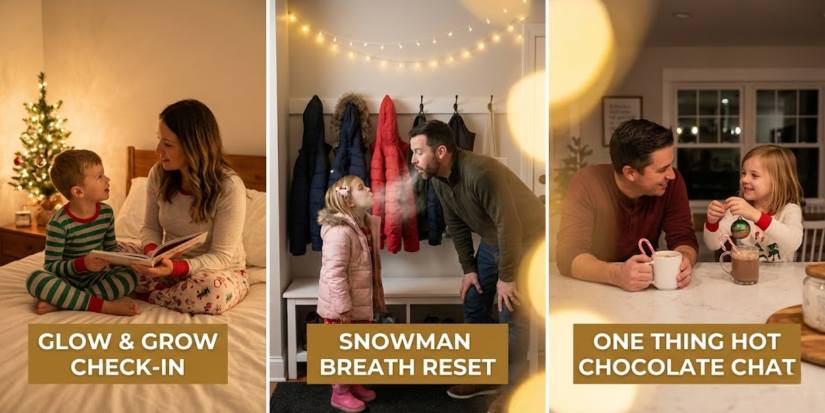
Then, at night, create a "Glow & Grow" check-in. In the last ten minutes before lights out, ask them to share one thing from their day that made them "glow" (feel happy or proud) and one thing that helped them "grow" (a challenge they faced or a mistake they learned from). This simple ritual builds incredible emotional intelligence and gives you a real window into their world, beyond the classic "fine" you get when you ask how school was.
Those little moments of coming and going are usually rushed and stressful. Let’s change that. Frame these daily transitions as opportunities for a quick, fun connection. Getting in the car to go to school? Invent a silly, holiday-themed handshake that only you two know. Or sing the exact same verse of "Jingle Bells" every single time, as loudly and badly as you can.
When you walk in the door after a long day, instead of launching into "take your shoes off, hang up your coat," try a one-minute "snowman breath" together. You both stand in the entryway, take a huge breath in, and then let it out with a long, slow whoosh, imagining you're melting away the stress of the day. It's a physical and emotional reset button that signals you're leaving the world's chaos behind. It's an almost laughably simple solution for how to connect with kids during busy holidays.
Sometimes the pressure to have a "big talk" is what stops us from talking at all. So, make it small. Create a simple ritual of having a quick cup of hot chocolate (or tea, or even just fancy water with a crazy straw) and asking just one, specific, open-ended question. This isn’t an interrogation; it’s a gentle invitation.
Forget "How was your day?" Try questions like, "What's one thing you're hoping for this holiday that isn't a gift?" or "If you could design a new ornament for our tree, what would it look like?" You’ll be stunned by the thoughtful answers you get when you give them a creative prompt to chew on. This easily becomes one of the most meaningful family activities for december without any elaborate planning.
The holidays can be a sensory and emotional minefield for kids, leading to meltdowns at the worst possible moments. When you see your child getting overwhelmed, a 5-minute co-regulating habit can be a lifesaver. Create a designated "Calm-Down Corner"—it doesn't have to be fancy, just a quiet spot.
When you see the storm clouds gathering, gently lead them there and say, "Let's go look at the snow globe for a minute." You sit together, quietly watching the glitter fall, and speak in hushed tones. You aren't punishing them; you are joining them in their chaos and showing them how to find their way back to calm. You are literally modeling how to regulate big feelings, building a foundation of emotional safety that will last a lifetime.
Let’s be honest, your partnership is often the first thing to get shoved to the bottom of the pile in December. This is non-negotiable. For just ten minutes after the kids are in bed—before you crash on the couch and turn on the TV—sit together without any screens. The only goal here is to feel heard. Each of you gets five uninterrupted minutes to share the most stressful or frustrating part of your day.
The other person's only job is to listen. Not to fix. Not to offer solutions. Just to listen and maybe say, "Wow, that sounds really hard." This simple act of validating each other's stress is one of the most powerful ways to reduce holiday stress for parents because it reminds you that you’re on the same team. You're in the trenches together.
Stop trying to find extra time you don't have and start piggybacking connection onto tasks you already have to do. Gift wrapping is a perfect example. Instead of one person hiding away to do it all, dedicate 10 or 15 minutes to tackling a few presents together. Put on some music, pour a drink, and just hang out while you do it. The shared, low-pressure activity creates a natural space for conversation to flow without the intensity of a face-to-face "we need to talk" moment.
When you're stressed, it's so easy to see only what your partner isn't doing. Your brain starts keeping a running tally of every forgotten task and every thoughtless comment. You have to consciously fight that. Make a deliberate habit of finding and naming one small, positive thing your partner did each day.
It can be so simple. As you're getting into bed, just say it out loud. "Hey, thank you for grabbing milk on the way home today. I know your day was crazy, and that really helped me out." A 2017 study in the journal Personal Relationships found that expressing gratitude to a partner is directly linked to feeling more connected and committed the very next day. It’s a tiny action with a huge return on investment.
You probably hug each other when you come and go, but it's likely a quick, perfunctory peck. Let's make it count. The next time one of you gets home, make it a rule to stop everything and have a real, deliberate, 20-second hug. Yes, twenty seconds. It might feel awkwardly long at first, but stick with it. Neuroscientists say that this is around the time it takes for the bonding hormone, oxytocin, to be released, which lowers cortisol (the stress hormone) and deepens feelings of connection. It’s a physical reset button for your nervous systems.
The holiday mess can feel like a tidal wave of clutter, right? Instead of nagging, turn the cleanup into a game. Create a daily ritual where you put on a killer holiday playlist (think Mariah Carey or the Trans-Siberian Orchestra), set a timer for ten minutes, and announce a "Tidy-Up Dance Party." The whole family works together at high speed to put one room back in order. It’s loud, it’s chaotic, and it turns a dreaded chore into a shared mission.
Dinnertime conversation can be hard to spark. The "Rose, Thorn, Bud" method is a classic for a reason. Go around the table and have each person share their "rose" (a highlight or something good that happened), their "thorn" (a challenge or something that was tough), and their "bud" (something they are looking forward to, specifically about the holidays). This structure gives everyone, from a talkative teen to a quiet five-year-old, a simple way to participate and share something real about their day.
One of the best ways to combat the "gimme-gimme" attitude of the season is to shift your family's focus from receiving to giving. Spend ten minutes together each evening on a "Kindness Countdown" mission. You can brainstorm ideas, like writing a thank-you note for your mail carrier or dropping off cookies for an elderly neighbor. Or you can take action, like going through toys to select a few to donate. This is how you build empathy and create meaningful family activities for december that look outward, not just inward.
Getting out to see the holiday lights is a classic, but you can make it so much more engaging than just a passive drive. Turn it into an interactive game that takes zero prep. As you walk or drive through a decorated neighborhood, play "I Spy" with the lights and displays. "I spy something that's blue and blinking," or "I spy an inflatable snowman." This is a perfect example of how to connect with kids during busy holidays by elevating an existing activity from something you watch to something you do together.
That box of ornaments holds more than just glitter and glass; it holds your family’s entire history. Don't let those stories stay in the box. As you decorate the tree, start a new micro-ritual. Whenever someone hangs an ornament that has a special meaning—a baby's first Christmas, a handmade creation from preschool, a souvenir from a trip—they take one minute to share the story or memory behind it. This transforms a simple decorating task into a rich, beautiful storytelling tradition that honors your shared past.
During the chaotic month of December, parents often find themselves acting as logistics managers rather than present family members, leading to stress and disconnection. The solution is not to add more to an already full plate but to integrate "micro-habits"—tiny, intentional rituals lasting just 10 minutes. These small, repeatable actions function as deposits into a family's "emotional bank account," building a reserve of goodwill and trust.
This approach bypasses decision fatigue by making connection automatic rather than another planned event. By focusing on presence over presents, these habits shift the season's values. The strategy offers specific 10-minute rituals for strengthening parent-child bonds, fortifying the couple's relationship amidst the holiday rush, and weaving connection into the fabric of daily family life, turning mundane moments into opportunities for genuine bonding.
Navigating teenage resistance requires a shift in approach from overt rituals to more subtle, respect-based connections. Instead of a prescribed "silly handshake," you might adapt the principle by focusing on shared interests. Use the "One Thing" Hot Chocolate Chat framework but apply it to their world; spend ten minutes listening to a song they love and ask what they like about it. The goal is to enter their space without forcing a specific activity. You could also modify the "Glow & Grow" concept into a casual check-in while doing a chore together, like loading the dishwasher, using language that feels more natural and less like a formal exercise. It’s about honoring their growing independence while still creating a pocket of your undivided attention. The key is to demonstrate that your interest is genuine, not just another parenting tactic.
For single parents, these micro-habits are less about adding another duty and more about making existing moments more restorative for both you and your children. The principle of presence over presents is even more critical. The "partner-focused" habits can be repurposed for vital self-care; the 10-minute "Tech-Free Stress Sync" can become your personal time to journal or listen to calming music, refilling your own emotional reserves so you have more to give. When interacting with your children, focus on the highest-impact, lowest-effort rituals like the "Festive First & Last," which provides crucial stability. This approach isn't about doing more—it's about getting more emotional value out of the moments you already have, reducing your own stress while simultaneously nurturing your child's sense of security.
When a partner is hesitant, the most effective strategy is to lead by example rather than seeking formal buy-in. Instead of proposing a new system, simply begin practicing the habits yourself. Start with the 20-second hug when they get home; the physical act of connection often communicates more than words can. Consistently practice micro-gratitude by verbally appreciating one small thing they did each day. According to research, expressing gratitude can directly improve feelings of connection. By making these small, positive deposits into the emotional bank account, you change the dynamic of your interactions. Often, a partner will begin to reciprocate naturally once they experience the benefits of these moments, such as reduced tension and increased warmth, without ever having to have a formal "we need to do this" conversation.
Consistency with a chaotic schedule comes from attaching habits to events, not to times. Instead of aiming for a ritual at 7:00 PM every night, anchor your micro-habits to daily transitions that always happen, regardless of the time. The "Transition Tunnels of Connection," such as doing a special handshake every time you get in the car, are perfect for this. The "Daily Re-entry Hug" is another powerful example that is cued by an event (a partner arriving home), not the clock. The "10-Minute Tidy-Up Dance Party" can happen whenever the mess hits a critical point. This flexibility is the core strength of the micro-habit approach. It’s about leveraging the small, predictable moments embedded within an unpredictable day, ensuring you can maintain connection without needing a rigid routine.
If you can only choose one habit, the deliberate 20-second hug is arguably the most powerful starting point. It requires no props, no planning, and very little time, yet it has a direct biological impact. Neuroscientists explain that a hug of this duration is needed to trigger the release of oxytocin, the "bonding hormone," which simultaneously lowers cortisol, the primary stress hormone. In a single, 20-second action, you are physically and chemically reducing stress for both yourself and your partner or child while reinforcing your bond. It serves as an immediate emotional reset, cutting through the tension of a hectic day. This habit perfectly embodies the core principle of achieving a significant connection through a minimal, almost effortless action, making it an ideal first step.
An interruption should be viewed as a modification, not a failure. The goal is progress, not perfection. If your planned 10-minute "Hot Chocolate Chat" gets cut short after three minutes by a phone call or a sibling squabble, that’s okay. You still secured three minutes of focused connection, which is a significant deposit into the emotional bank account. The key is to acknowledge the interruption without letting it derail your intention for the entire day. You can simply say, "I loved hearing about that. Let's talk more later." Then, you can pivot to an even smaller micro-habit later on, like an extra squeeze of the hand or a shared glance across the room, to reinforce the connection. This mindset prevents the all-or-nothing thinking that can sabotage good intentions.