
Text Templates for Couples (That Don’t Make It Worse)
If you’ve ever typed a message with good intentions and accidentally triggered a bigger fight, you’re not alone. This page gives you a professional, practical set of copy‑paste templates to de-escalate, repair, and reconnect—plus guidance on which message to use when.
Clinical mindset: A good text lowers defensiveness, shows accountability, and sets a clear next step—without forcing an instant reply.
The real problem you’re solving
📱The “tone gap”
Text strips out warmth, facial cues, and repair signals. Your partner reads your message through their stress, not your intention.
🧨Escalation loops
Once both people feel blamed, texts turn into fast back‑and‑forth proof battles. Repair becomes harder the longer it runs.
🧩Wrong “love channel”
You may try to repair with logic or gifts, when your partner needs time, reassurance, or a concrete action.
What “good” looks like (analysis)
A repair text is a small “repair attempt” designed to reduce tension and re‑open cooperation. The Gottman Institute describes repair phrases like “Let me try again” and “I’m sorry” as tools to de‑escalate when conversations get tense.
If fights are intense or frequent, use a structured workflow (timeouts + restart) instead of trying to fix everything via texting.
How to choose the right text (fast)
1️⃣If you’re heated
Use a “pause + return time” message. Your goal is nervous‑system downshift, not persuasion.
2️⃣If you hurt them
Use accountability + impact + next step. Skip explanations until the temperature drops.
3️⃣If you feel lonely
Use a clear request (time, tone, task) rather than a test (“Do you even care?”).
Pro tip: Keep texts under 3–5 sentences. If you need more, schedule an in‑person talk.
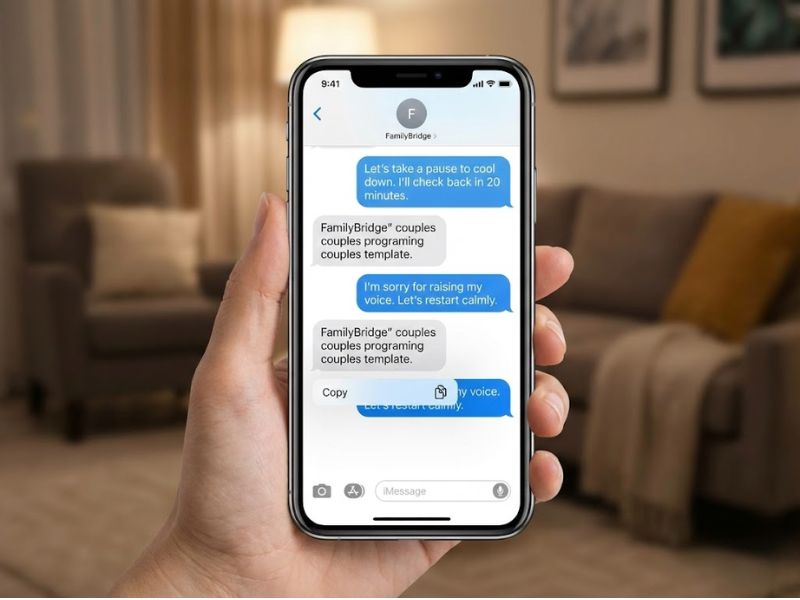
Text templates: De-escalate (stop the spiral)
Why it works: It lowers pressure, names a return time, and keeps “us” as the unit.
This adds a concrete time block, which helps “Quality Time” partners feel repair is real.
Text templates: Accountability (clean apologies)
If you want to add more explanation, do it after your partner feels understood.
The Gottman Institute lists phrases like “Let me try again” as a repair tool when tension rises.
Text templates: Clear requests (no mind-reading)
This works well for “Quality Time” partners because it’s concrete and low-pressure.
Ownership beats “tell me what to do” for many couples, because it reduces mental load.
Make your texts land (love-language translation)
Conclusion (what to do next)
Use your partner’s top 1–2 love languages to choose your “ending line.” If their top need is Quality Time, end with a time block. If it’s Acts of Service, end with a concrete task you’ll take. If it’s Words, end with sincere appreciation and reassurance.
If you don’t know their top needs, start with the Love Language Quiz and focus on the top 2–3 results.
Frequently Asked Questions
They work when they capture real accountability and a clear next step, and they fail when they sound like a corporate apology. The goal isn’t perfect wording—it’s lowering defensiveness (no blame), showing care (a “we” frame), and making a simple request you can follow through on.
Use texting to pause escalation, take responsibility, and schedule a calmer conversation. Avoid complex problem-solving over text when either of you is activated (angry, flooded, defensive). If the issue is sensitive or keeps looping, use text to set up an in-person talk with a time and topic boundary.
Treat silence as data, not a verdict. Send one follow-up that reduces pressure (“No need to reply right now; I’ll be ready at 7pm if you want to talk.”). If silence is a repeated pattern, the repair isn’t more texts—it’s agreeing on a pause-and-return plan (how long the break is, and when you reconnect).
Love languages help you translate the repair into the channel your partner can actually feel. For example, if their top need is Quality Time, the best “repair text” ends with a concrete time block. If their top need is Acts of Service, it ends with ownership of a specific task (start to finish).
No. Templates can support reconnection and reduce escalation, but they don’t replace boundaries, accountability, and sustained behavior change—especially after repeated lying, secrecy, or ongoing disrespect. If trust is broken, use a structured repair plan and consider professional support.
Educational use only. If you feel unsafe or there is intimidation, coercion, or violence, prioritize safety and seek local support.