March 2, 2026

Apology Text to My Wife After I Yelled – 3 Real Versions That Help Apology Text to My Wife After I Yelled: 3 Versions That Actually […]



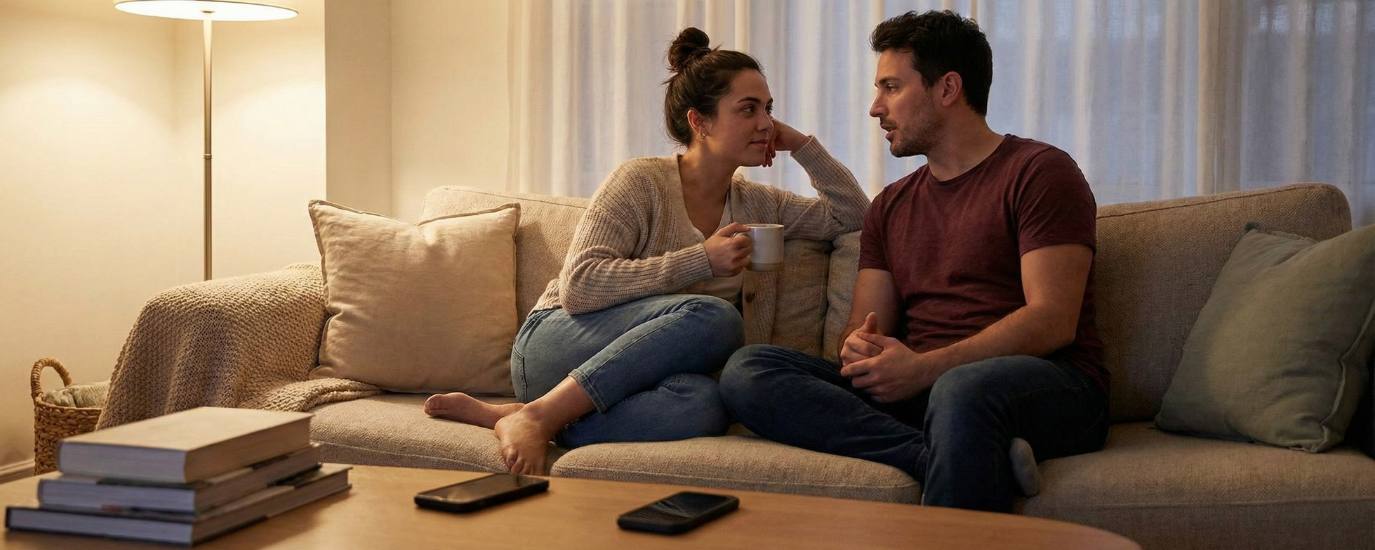
I know the scene all too well. You finally sit down after a long day, hoping to connect with your favorite person. You start sharing a story—something funny that happened at work, a worry that’s been nagging at you—and you see it. The subtle downward glance, the faint glow of a screen reflecting in their eyes, the thumb making that familiar scrolling motion. Maybe they even murmur an automatic, "uh-huh," but you know they haven't heard a single word. In that moment, a little something inside you just… deflates. That sting of feeling unheard by my partner is a unique kind of lonely, isn't it?
You’re not just imagining it, and you're certainly not alone in this struggle. This is the new normal for so many of us. We're living in an age of constant dings, pings, and endless to-do lists buzzing in our brains. It’s a full-on attention crisis. Our minds are pulled in a thousand directions by work stress, family duties, and the endless, curated perfection we see online. So, when we finally get a moment with our partner, we’re often running on empty, bringing only the mental and emotional scraps of our day to the table. And this isn't a small thing; it’s the slow, quiet erosion of intimacy, one missed connection at a time.
But what if I told you there’s a way to cut through that noise? What if the most powerful tool you have to rebuild that connection isn't some grand, complicated gesture, but a skill you can start practicing tonight? I’m talking about active listening. And let’s be clear: this isn’t just about putting your phone down and making eye contact. It’s about giving the most valuable thing you have—your undivided presence. It’s a conscious choice to offer a safe harbor for your partner's thoughts and feelings, especially when it's hard. Mastering active listening techniques for couples is a total game-changer, turning that awful feeling of feeling unheard by my partner into moments of genuine validation and understanding.

I'm not here to give you a bunch of academic theory that sounds good on paper but falls apart in real life. My goal is to hand you a practical, step-by-step roadmap. Think of me as your friend who’s been through it and has found what actually works. We're going to break down exactly how to improve communication in a relationship, even when you’re both tired and stressed. We’ll cover everything from foundational mindsets to specific communication exercises for distracted partners that you can try without feeling awkward or phony. This is about learning to listen with your whole being, so your partner not only hears your love but feels it, too. Ready to get started?
Let’s just get real for a moment. If you feel like you're losing the battle for your partner's attention, it’s not because your relationship is uniquely broken. It’s because the world we live in is actively working against deep, focused connection. The deck is stacked against you, and understanding why is the first step toward reclaiming that ground. We have to diagnose the illness before we can find the cure.
That little glowing rectangle in your partner's hand? It’s more than just a phone. It's a firehose of dopamine, a portal to endless distraction, and a very real barrier between the two of you. Researchers at Baylor University found that a staggering 46.3% of people have been "phubbed"—phone snubbed—by their romantic partner. It's an epidemic.
Every notification that pings is a tiny, neurological interruption. It pulls your partner’s brain out of the conversation with you and into a completely different context. They might look up and say, "Sorry, what were you saying?" but the thread is already broken. Their focus is fractured. And that constant, low-grade feeling of competing for attention is utterly exhausting.
Beyond our screens, modern life itself is a relentless treadmill. We're juggling demanding careers, financial stress, kids' schedules, and the invisible mental load of running a household. By the time 8 p.m. rolls around, most of us don't have much left in the tank. We're mentally and emotionally spent.
This isn’t a personal failing; it's a cultural one. The pressure to be productive and "on" 24/7 leaves zero margin for the kind of patient, empathetic listening a relationship needs to thrive. Your partner isn't choosing to be distracted; often, their brain is simply at full capacity, with no room left to genuinely process what you're saying.
And here's the kicker: this environment is literally changing how our brains work. A famous Microsoft study found that the average human attention span has shrunk to a mere eight seconds. Eight. Seconds. We’re conditioned by short-form videos, scrolling newsfeeds, and constant multitasking to seek out novelty and quick information hits.
Sustained, nuanced conversation feels… hard. It feels slow. It requires a type of mental muscle we're not exercising nearly enough. So when your partner’s eyes glaze over during a longer story, it’s not always boredom. It can be a genuine cognitive struggle to stay locked in when their brain has been trained for rapid-fire input.
Sometimes the biggest distraction isn't in the room at all. It's the "internal static" playing on a loop inside our heads. Unresolved arguments from last week, simmering resentments from last year, personal anxieties about work, or deep-seated insecurities can make someone physically present but a million miles away.
If your partner is mentally replaying a conflict with their boss or worrying about a bill, they can’t be fully with you. This is one of the most painful forms of distraction because it feels so personal. It’s the source of that gut-wrenching experience of feeling unheard by my partner, even when all the external distractions are gone.
This isn't just a minor annoyance. Chronic inattention is poison to a relationship. It starts with small misunderstandings that fester and grow. Then comes a profound sense of loneliness—the feeling of being alone even when you’re together. This emotional distance inevitably bleeds into physical intimacy, creating even more space between you.
Slowly but surely, trust begins to erode. You stop sharing the important stuff because you assume you won’t be heard anyway. This cycle is how good relationships quietly fall apart. Understanding how to improve communication in a relationship starts by recognizing this dangerous spiral and making a conscious choice to stop it.

Alright, now that we've stared into the abyss of modern distraction, let's talk about the way out. The solution isn't a list of hacks or tricks. It’s a fundamental shift in your entire approach to conversation. These aren't rules; they are principles—a new mindset for showing up for your partner.
This is so much more than just putting your phone in another room. Committing to presence is an active, mental decision. It means you consciously choose to set aside your own buzzing thoughts, your counterarguments, your to-do list, and your worries. You are creating a clean, quiet space in your mind dedicated entirely to them.
It means when they speak, you’re not spending that time formulating your brilliant rebuttal. You're not waiting for your turn to talk. You are offering them the rarest gift in the modern world: your complete and undivided attention. It's a form of conversational mindfulness.
Most of us listen with the intent to respond. We’re halfway into our own sentence before our partner has even finished theirs. Active listening flips that script entirely. Your one and only goal in that moment is to fully comprehend their world. What are they really saying? What emotions are hiding beneath the words?
Think of yourself as a journalist trying to get the full story, not a debater trying to win a point. Your mission is pure understanding. When you adopt this mindset, your entire posture changes. You lean in. You become curious. And your partner will feel that shift instantly.
Here's a truth that can save your relationship: validation is not the same thing as agreement. You don’t have to think your partner is "right" to validate their feelings. Validation is simply the act of acknowledging their emotional experience as real and legitimate. It’s verbalizing that you get it.
It's the difference between saying, "You're overreacting," and saying, "I can see how that would feel incredibly frustrating for you." That single sentence can de-escalate a potential fight in seconds. It tells your partner, "You are not crazy for feeling this way. I see you." It’s the key to creating emotional safety.
For your partner to be truly open and vulnerable, they have to feel safe. And nothing shuts down vulnerability faster than the fear of judgment, criticism, or blame. Active listening requires you to consciously suspend your own judgment while your partner is sharing.
This means biting your tongue when you want to say, "I told you so," or, "You should have..." It’s about creating a conversational safe harbor where they can bring their whole, messy, imperfect selves without fear. When they know they won't be judged, they'll tell you what's really going on.
Words are only a fraction of the message. So much of what we communicate is non-verbal. Are they avoiding eye contact? Is their jaw tight? Is their voice higher or quieter than usual? Are they slumped in defeat or rigid with anger? These are all critical pieces of the story.
Listening with your eyes and your gut is just as important as listening with your ears. It helps you hear the emotion behind the content. When you can say, "You're saying you're fine, but you seem really tense," you're showing that you are paying attention on the deepest level possible.
Okay, you’ve got the mindset down. Now, let’s get our hands dirty with some practical, actionable tools you can start using tonight. Think of these as the real-world application of the principles we just covered. These are not scripts to be memorized, but methods to be practiced until they feel like second nature.
This is the foundational skill. After your partner shares something, you gently paraphrase it back to them to ensure you understood correctly. It feels simple, but it’s magic. It forces you to actually listen instead of just waiting to talk, and it shows your partner you’re genuinely engaged.
Try starting with phrases like:
"Okay, so if I'm getting this right, you felt..."
"It sounds like the main thing that upset you was..."
"So what I'm hearing is that you're worried about..."
This isn't about being a parrot. It's about summarizing the essence of what they said—both the facts and the feelings—to confirm you’re on the same page.
The questions you ask can either shut a conversation down or open it wide up. Closed-ended questions get you a "yes," "no," or one-word answer. Potent, open-ended questions invite reflection and sharing. It’s one of the simplest communication exercises for distracted partners you can do.
Swap this: "Did you have a good day?" For this: "What was the most interesting part of your day?"
Or this: "Are you mad at me?" For this: "How are you feeling about what just happened between us?"
Clarifying questions are also a game-changer. Use phrases like, "When you say you feel 'stuck,' what does that look like for you?" This invites them to go deeper.
You don’t have to interrupt to show you’re listening. Minimal encouragers are the small verbal and non-verbal cues that say, "I'm with you. Keep going." Things like nodding, making eye contact, and simple utterances like "uh-huh," "I see," or "wow" are incredibly powerful.
They work like conversational green lights, encouraging your partner to continue without breaking their train of thought. It’s a quiet way of showing you're tracking with them every step of the way.
This one is a little more advanced, but it is life-changing. It involves listening for the underlying emotion your partner is expressing and gently naming it for them. This act of "emotion labeling" can be profoundly validating and helps your partner gain clarity on their own feelings.
It might sound like:
"Wow, it sounds like you felt really betrayed when that happened."
"That sounds incredibly overwhelming."
"I can hear the disappointment in your voice."
When you accurately name an emotion, you're telling your partner, "I don't just hear your words; I feel your heart."
For those really big, emotionally charged conversations, sometimes you need more structure. The Speaker-Listener Technique is one of the most effective communication exercises for distracted partners available. One person is the "Speaker" and can talk without interruption. The "Listener's" only job is to listen and then paraphrase what they heard until the Speaker feels fully understood. Then you switch roles.
It slows things down, prevents arguments from escalating, and ensures both people walk away feeling heard. It can feel a bit formal at first, but for tough topics, it's an absolute lifesaver.
Let's be honest: putting this into practice is going to be messy. You’ll stumble. It will feel awkward at first. You’ll revert to old habits when you’re tired or stressed. That’s okay. The goal isn’t perfection; it’s progress. Here’s how to handle the most common roadblocks you’re sure to face.
Someone says something critical, and you can feel it—your heart races, your stomach clenches, and you have an overwhelming urge to interrupt and defend yourself. Defensiveness is the arch-nemesis of listening. The moment it shows up, learning stops.
Your job is to recognize those physical cues. When you feel it rising, take a deep breath. Literally. Buy yourself a few seconds to let the initial emotional wave pass before you respond. If you need to, you can even say, "Okay, what you just said really landed hard. I need a minute to process it before I reply."
So often, when our partner shares a problem, our first instinct is to jump into solution mode. We want to fix it, offer advice, and make the problem go away. While well-intentioned, this often makes our partner feel dismissed. They didn't want a consultant; they wanted a confidant.
Here’s a magic question to keep in your back pocket: "Are you looking for help solving this, or do you just need me to listen right now?" This simple question honors their needs and is a cornerstone of how to improve communication in a relationship. Nine times out of ten, they just want to be heard.
When you first start using techniques like paraphrasing, it can feel robotic or clinical. Your partner might even say, "Stop using that therapy voice on me!" This is a normal part of the learning curve. The key is to move from "doing" a technique to "being" a listener.
Don't just mimic the sentence starters. Find your own words. The goal is to internalize the principle of curiosity and validation so the techniques become a natural extension of your genuine desire to understand. It takes practice, but eventually, it will feel like you.
Some days, you're just too exhausted, overwhelmed, or emotionally raw to be a good listener. And pretending to listen when you don't have the capacity is worse than being honest. Trying to listen with an empty tank will only lead to frustration for both of you.
In these moments, it’s okay to call a respectful time-out. Try saying something like, "I can see this is really important to you, and I want to give you my full attention. But I'm completely wiped out right now. Can we please set aside time to talk about this tomorrow morning when I'm fresh?" This validates their need while respecting your own limits.
What if you're putting in all this effort, but your partner is still scrolling through their phone? This is incredibly frustrating. First, don't give up. Consistently modeling good listening is the best way to teach it. People often start to mirror the behavior they receive.
If that doesn't work, you may need to have a gentle conversation using "I" statements. For example, "When we're talking and I see you on your phone, I feel hurt and unimportant because it seems like I don't have your attention." This focuses on your feeling, not their blame. If the pattern persists, it might be a sign that a professional's help is needed to get to the root of the disconnect.
This is an incredibly common and understandable reaction when you first begin practicing active listening techniques. It's a signal that you're in the learning phase, where the methods can feel more like a script than a natural expression of care. The key is to acknowledge their feedback without getting defensive. You could say something like, "I hear you. It probably does sound a bit strange because I'm really trying to listen differently. My only goal is to make sure I understand you better." The objective is to shift from consciously "doing" the technique to genuinely "being" a curious and present listener. Over time, as you internalize the core principles of validation and understanding, the sentence starters will fade away and be replaced by your own authentic words.
Applying active listening when emotions are high is challenging but essential for de-escalation. The first and most critical step is self-regulation. When you feel your defensiveness rising—a racing heart, the urge to interrupt—you must pause. Take a deep breath to calm your nervous system before you respond. If the conflict is too intense, it is wise to use a structured approach like the Speaker-Listener Technique. This method forces a slowdown by assigning one person the role of Speaker, who can talk without interruption, while the Listener's only job is to hear them out and paraphrase what was said. This prevents the argument from spiraling and ensures both parties feel heard, which is often the first step to resolving the underlying issue.
Active listening is not about scheduling lengthy, formal "communication sessions" every day. It's about changing the quality of your daily interactions, big and small. The real transformation happens when you integrate these skills into the fabric of your relationship. You can practice by swapping a closed-ended "Did you have a good day?" for an open-ended "What was the most interesting part of your day?" This invites a more meaningful, two-minute exchange. Using minimal encouragers like nodding or saying "I see" while your partner recounts a brief story also counts. While setting aside dedicated, distraction-free time for bigger topics is vital, the power of this practice comes from its consistent application in everyday moments.
The core principles of active listening are just as applicable, if not more so, in a long-distance relationship; you just adapt the tools to the technology. Since you can't observe full body language, "listening with all your senses" becomes "listening with focused ears." Pay close attention to your partner's tone of voice, their pace of speech, and the pauses between their words—these are rich with emotional data. Committing to presence means scheduling video calls where both of you agree to close other tabs and put phones away. Reflective listening is even more crucial to prevent misunderstandings, as is asking clarifying questions. The goal remains the same: creating a dedicated space where your partner feels fully seen and heard, even across the distance.
It is never too late to improve communication, but it requires commitment and patience. When negative patterns are deeply entrenched, change will not happen overnight. The most effective starting point is to focus on what you can control: your own behavior. Begin by consistently modeling good listening without demanding immediate reciprocation. Your partner will start to notice the shift. Use "I" statements to express your needs gently, such as, "I feel disconnected when we don't have a chance to talk without distractions." If you find your efforts are consistently met with resistance or the same negative cycles persist, it may be a signal that deeper issues are at play, and the support of a couples' therapist could be instrumental.
This is a very common dynamic, often stemming from a genuine desire to help, but it can leave the speaker feeling unheard and dismissed. Your partner likely believes they are showing love and support by offering solutions. The most effective strategy is to be direct, yet gentle, about your needs in the moment. Before you start sharing, you can preface it by saying, "I have something I'd love to vent about. I'm not looking for solutions right now, I just really need you to listen and hear me out." An even more powerful tool is to use the direct question provided in the toolkit: "Are you looking for help solving this, or do you just need me to listen right now?" This question educates your partner on your needs without making them feel criticized.
In a world saturated with digital interruptions and the pressures of an "always-on" culture, modern couples face a crisis of connection. Our attention spans have shrunk, with studies showing the average is now a mere eight seconds, making sustained conversation difficult. This constant distraction, fueled by everything from phone notifications—with research indicating 46.3% of people have been "phubbed" by a partner—to internal stress, erodes intimacy, fosters loneliness, and can send a relationship into a downward spiral. This article provides a roadmap to counteract these forces through the practice of active listening. It moves beyond simple advice, establishing foundational principles like committing to full presence, listening to understand rather than to reply, and offering validation without necessarily agreeing. Creating a non-judgmental space and listening with all senses are key to building the emotional safety required for genuine openness and vulnerability with your partner. To make these principles actionable, the guide offers a practical toolkit for daily use. Techniques such as reflective listening (paraphrasing), asking potent, open-ended questions, and using minimal encouragers demonstrate engagement and foster deeper sharing. For more challenging conversations, structured methods like the Speaker-Listener Technique can prevent escalation. The article also addresses common roadblocks, including managing defensiveness, resisting the urge to "fix" problems, and finding authenticity in the practice. It provides strategies for when you or your partner lack the capacity to listen, reinforcing that active listening is a rewarding, ongoing practice that rebuilds connection.