December 17, 2025

Stop Renting Your Budget: Why Smart Spreadsheets Are The Real “Mint Killer” in 2025 By Sarah | Updated: December 2025 Let’s be honest: paying a monthly […]



Feeling the holiday heat? You're not alone. This is the practical, empathetic guide you need to navigate the emotional minefield of celebrating both Hanukkah and Christmas. We're getting real about the most common interfaith marriage holiday challenges, moving beyond the arguments to help you build a season of joy and connection that honors both of you. No fluff, just real strategies that work.
So, you're staring down the calendar, and the pressure is already building, isn't it? One of you grew up with the scent of pine needles and Christmas carols, the other with the glow of the menorah and the sizzle of latkes. You fell in love with a person, not their religion, but now the holidays are forcing you to confront just how different your worlds can be. I get it. I’ve talked to so many couples who feel that familiar knot in their stomach as December approaches, turning what should be a joyful time into a minefield of potential arguments. This is the classic December dilemma for interfaith couples.
It’s about so much more than just a tree versus a menorah. These traditions are wrapped up in decades of memories, family identity, and a deep-seated sense of "this is how it's supposed to be." So when you try talking about blending traditions in an interfaith family, it can feel like you're asking your partner to give up a piece of their soul. And let's be honest, the pressure from in-laws doesn't exactly help. It’s a tough spot to be in.
Your annual discussion probably starts with a simple question like, "So, what are we doing for the holidays?" but quickly spirals into a tense negotiation. It feels less like festive planning and more like a diplomatic crisis. The core of the problem often isn't about belief, but about belonging and being seen. It's about figuring out how to celebrate Hanukkah and Christmas together in a way that doesn't make one partner feel like their history is being erased or minimized in their own home. It’s exhausting.
You love each other deeply, yet this time of year brings out some of the most profound interfaith marriage holiday challenges. Every decision, from what decorations go up to which family you visit on which day, feels loaded with meaning. It's so easy to feel misunderstood or like you're the only one compromising. You might even be wondering if you’ll ever get it right. You absolutely can, but it requires a new game plan.
But what if this year could be different? What if, instead of bracing for impact, you could actually look forward to this season? This article is your new playbook. I’m not going to give you clichéd advice. We're going to cut to the chase and talk about what really works. We will tackle the emotional reality of the December dilemma for interfaith couples head-on, giving you tools to communicate what you truly need.
This is about more than just surviving the holidays; it's about using this time to build a stronger, more resilient partnership. It's a chance to get creative with blending traditions in an interfaith family, creating something unique and beautiful that belongs just to you. You can build a season that feels authentic, respectful, and genuinely joyful for you both.
So grab a cup of something warm. Let’s talk about how to celebrate Hanukkah and Christmas together without losing your minds—or each other. It’s possible to turn this point of friction into your greatest source of connection. You just need the right tools and a little bit of guidance, and that's exactly what I'm here to provide. Let’s get started.
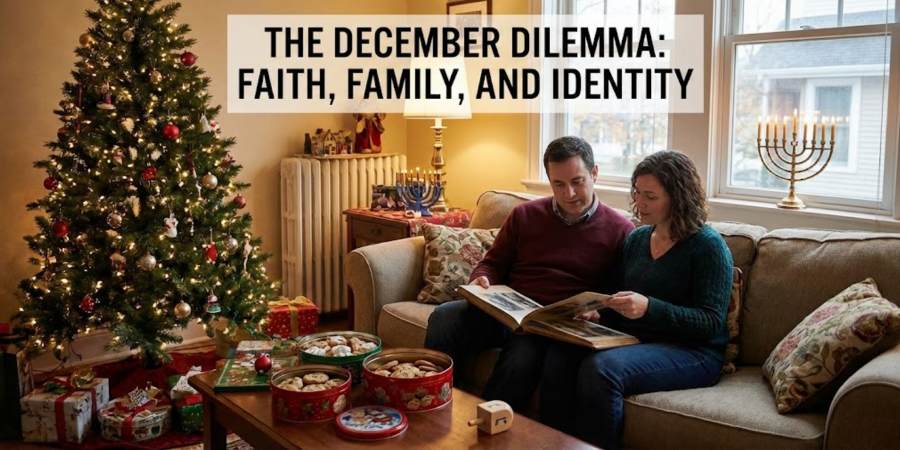
Before you can even think about solutions, you have to get brutally honest about what you're up against. These aren't simple disagreements over decorations; they are deeply emotional, cultural standoffs. It feels so personal because it is personal. Your entire history, your family’s history, is wrapped up in the scent of a Christmas tree or the light of a menorah. Let's pull back the curtain on why this time of year is so uniquely charged.
Let’s call it what it is: Christmas is a cultural juggernaut in America. It's everywhere—in stores, on the radio, at work. For the Jewish partner, this can feel incredibly isolating. Your holiday, Hanukkah, which is historically a minor festival, has been elevated in the U.S. largely to create a parallel experience for Jewish children. So, you're already starting from a place of cultural imbalance, trying to make your traditions feel just as "big" and important in a world saturated with Santa Claus.
You must understand that when you talk about changing a holiday tradition, you're not just moving furniture around. You're fiddling with the anchor of your partner's identity. That specific, slightly-burnt sugar cookie recipe is a direct line to their grandmother's kitchen. The ritual of lighting the menorah connects them to generations of ancestors. These aren’t just "things we do"; they are tangible links to love, memory, and belonging. Messing with that can feel like a profound rejection of who they are and where they come from.
Nowhere does this get more heated than with the big symbols. For your Christian partner, that tree likely has nothing to do with Jesus. It's the symbol of family gathering, of childhood wonder, of a cozy and festive home. It’s pure joy. But for you, the Jewish partner, seeing that same tree in your living room can feel like a profound betrayal of your identity. It's the most visible symbol of a faith you don't share, and for some, it carries the historical weight of forced conversion and persecution. Both feelings are completely valid.
Here is where you can find some breathing room. You have to learn to separate the theology of the holiday from its cultural expression. Christmas, at its core, is about the birth of the Christian savior. But for millions, it's also a cultural season of generosity, family meals, and festive music. Hanukkah celebrates religious freedom and a miracle of light. It's also about fried foods, spinning dreidels, and giving gifts. Identifying the cultural parts you can both enjoy is a game-changer. You can share a festive meal without sharing a creed.
And we have to talk about the fear of assimilation. It's real, and it often weighs more heavily on the Jewish partner. Given that Jews are a small minority, there's a legitimate concern that embracing Christmas traditions will lead to a dilution of Jewish identity, especially for your children. When you see data from the Pew Research Center showing nearly 40% of people who married after 2010 are in an interfaith marriage, you realize this isn't an isolated fear. It's a community-wide conversation about survival and continuity.
Okay, so the challenges are real and they are deep. But they are not insurmountable. The solution isn't a magic wand; it's a blueprint built on radical communication and profound respect. You have to stop treating this like a battle to be won and start treating it like a project you’re co-managing. This is where you roll up your sleeves and do the work—together.
The single worst time to decide on your holiday plan is on December 1st, when the pressure is on and emotions are high. You need to start this conversation months in advance. Frame it positively: "Hey, I want to make sure we create a holiday season that feels amazing for both of us. Can we sit down next week and dream up what that looks like?" This turns it from a confrontation into a collaboration.
This is the most important question you can ask each other: "What feeling are you trying to capture this holiday?" Forget the "what" for a second and focus on the "why." Does one of you need to feel a sense of cozy nostalgia? Does the other need to feel a connection to heritage? Once you know the underlying emotional goal, you can find a dozen different ways to achieve it. It moves the conversation from "We have to get a tree!" to "How can we make our home feel festive and full of wonder?"
Each of you gets a very short list of non-negotiables—maybe one or two things, tops. These are the traditions that are absolutely essential to your soul. You have to explain why they are so critical. Then, you each make a much longer list of the "flexibility zones"—the things you enjoy but are willing to modify, blend, or let go of. This exercise reveals where your true priorities lie and where there's room to play.
You're probably used to listening for your chance to jump in and make your point. I'm asking you to do the opposite. When your partner is talking, your only job is to understand their world. Validate their feelings, even if you don't agree. Saying "I can hear how much it hurts you to think about not having a tree, and I understand it's tied to memories of your dad" doesn't mean you've agreed to the tree. It means you've seen your partner's heart. That changes everything.
Finally, you must agree that the two of you are the final authority. Not your mom, not his grandpa, not your rabbi or his pastor. You two. The plan you create inside your "couple bubble" is the plan, period. You must become a rock-solid, united front. Once a decision is made, it is presented to the outside world as "We have decided..." This protects your partnership from the inevitable onslaught of outside opinions and guilt trips.
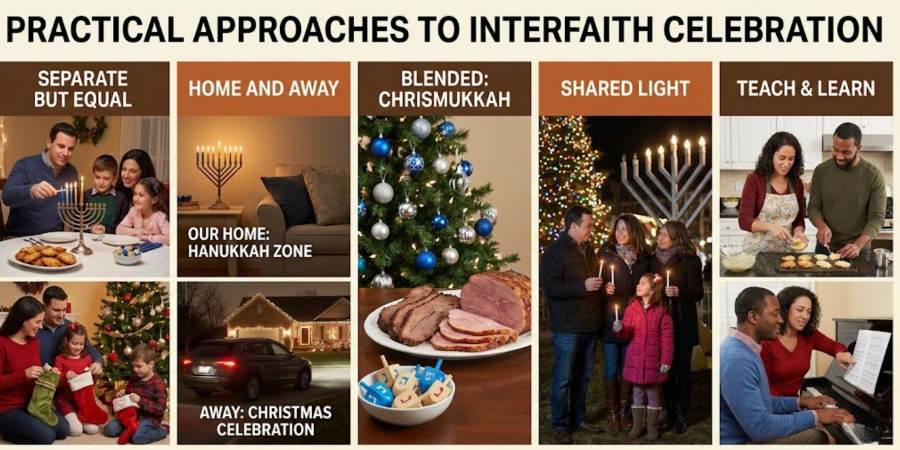
Once you've built that foundation of communication, it's time to design what your holiday actually looks like. There is no one-size-fits-all answer for how to celebrate Hanukkah and Christmas together. The goal is to find a model that feels authentic and joyful for your unique family. Think of these less as rigid rules and more as a menu of options you can mix and match.
This is often the simplest and cleanest approach. You decide to celebrate both holidays to the fullest, but distinctly. For the eight nights of Hanukkah, your home is a Jewish home: you light the menorah, say the blessings, eat latkes, and play dreidel. Then, on Christmas Eve and Christmas Day, you fully embrace Christmas traditions: a special meal, stockings, and maybe attending a service if that's important. There’s no blending, just mutual respect and participation in each other's celebrations.
Sometimes, the simplest solution is about location. You might decide your shared home will be a "Hanukkah zone" to ensure those traditions get the space they need without being overshadowed. Then, you travel to the Christian partner's family for a full-blown "Christmas experience." This can be a great way to honor both traditions without turning your living room into a battleground, easing much of the tension in the December dilemma for interfaith couples.
This is the creative, and sometimes controversial, path of blending traditions in an interfaith family. Some families find immense joy in creating new rituals. This could look like a "Hanukkah bush" (a tree decorated with blue, white, and silver ornaments), serving brisket alongside a Christmas ham, or hosting a party that features both eggnog and sufganiyot. The key is that you're creating something that represents your unique union, not just smashing two holidays together without intention.
A truly beautiful approach is to build your celebrations around the universal values that both holidays share. Both Hanukkah and Christmas are festivals of light in the darkest time of year. They are both about hope, miracles, family, and rededication. You could plan your season around a "Festival of Lights" theme, volunteer at a charity together, or establish a new family tradition of driving around to see holiday light displays, appreciating them all as symbols of shared hope.
Frame this entire season as an incredible educational opportunity for each other and for your kids. You're not just tolerating another religion; you are actively and joyfully learning about it. The Christian partner can master the art of the perfect latke. The Jewish partner can help pick out a beautiful poinsettia and learn the words to a cultural carol. This turns potential conflict into a gift of mutual enrichment, making your family culture deeper and more interesting.
Often, the biggest interfaith marriage holiday challenges don't come from within your marriage, but from the well-meaning (and sometimes not-so-well-meaning) people outside of it. Your families have expectations, and they can be deeply attached to doing things "the way we've always done them." Navigating this requires a spine of steel and a whole lot of love.
This is non-negotiable. Before you speak to any family members, you and your partner must be in complete agreement and have your story straight. You use "we" statements exclusively. "We've decided to spend Christmas morning at our house this year to start our own tradition." It's not "He wants to..." or "She feels we should..." Using "we" sends a clear, powerful message that the decision is made and the discussion is closed.
You can acknowledge your family's feelings without caving to their demands. It sounds like this: "Mom, I know how much you love having everyone for the tree trimming on the 23rd, and we love it too. This year, we'll be lighting the sixth candle of the menorah with the kids, but we would love to come over for dessert afterward." It’s a loving "no, but." You validate their tradition while holding firm to your own family's plan.
One of the best ways to get family on board is to make them a part of your new, blended world. If you're solving the puzzle of blending traditions in an interfaith family, invite them to see the beautiful result. Ask your Jewish mother-in-law to come over and teach the family how to make her famous brisket. Ask your Christian dad to read "'Twas the Night Before Christmas" to the grandkids. When they feel included and honored, they're much less likely to feel resentful.
You have to be proactive about gifts, especially if you're raising your children in one specific faith. Have a direct, gentle conversation with grandparents beforehand. "We're so grateful for your generosity. Since we are raising the kids Jewish, we'd ask that you avoid overtly Christian gifts like nativity sets. They would absolutely love [insert other ideas here]." It can feel awkward, but it avoids so much confusion and conflict later on. This is one of the thorniest interfaith marriage holiday challenges.
Remember, you are not alone in this. There are thousands of couples figuring out how to celebrate Hanukkah and Christmas together. Seek them out. Organizations like 18Doors offer incredible resources, articles, and connections to local communities of interfaith families. Just knowing there are other people facing the exact same December dilemma for interfaith couples can be an enormous source of strength and validation. You don't have to reinvent the wheel all by yourself.
For interfaith couples, particularly those blending Jewish and Christian backgrounds, the holiday season presents a unique set of emotional and cultural challenges. Successfully navigating this "December Dilemma" hinges not on winning arguments over traditions, but on collaborative creation. The key is to shift from conflict to a co-management project by understanding the deep-seated power of nostalgia, family identity, and potent symbols like the Christmas tree and menorah.
Building a foundation of proactive and empathetic communication is essential. This involves discussing holiday plans months in advance, defining each partner's core emotional needs, and identifying non-negotiable traditions versus areas of flexibility. By establishing the couple as the primary decision-making unit, partners can then choose a celebration model that feels authentic—whether it's celebrating each holiday separately, blending them into new traditions, or focusing on shared universal values like light and hope. Finally, presenting a united front is crucial for managing external pressures from family and creating a holiday season that strengthens the partnership.
A disagreement over a Christmas tree is rarely about just the tree; it touches on deep-seated issues of identity and belonging. The first step is to move beyond the object and discuss the "why" behind each person's position. For the Christian partner, the tree often symbolizes childhood joy, family gatherings, and festive wonder, separate from religious dogma. For the Jewish partner, it can represent the dominant culture or feel like a betrayal of their own heritage and a symbol of historical persecution. Validating these feelings is crucial. Saying "I understand this connects you to your family" shows you are listening.
From there, you can explore practical compromises discussed in various models. The "Home and Away" strategy might work, where the tree is celebrated at a parent's house, not your own. Alternatively, you might explore a blended approach, such as a non-traditional "winter tree" with neutral, secular decorations. The goal is not for one person to win, but to find a solution that respects both partners' deeply held feelings and boundaries, ensuring both feel seen and honored in their shared home during the holidays.
Clarity and joy are your most powerful tools when explaining blended traditions to children. Frame your family's approach as a unique and special story. You can explain it as, "Our family is built from two wonderful backgrounds, so we get to celebrate the best of both!" Use the "Teach and Learn" model by making education an active part of the celebration. Read children's books about both Hanukkah and Christmas. When you light the menorah, tell the story of the Maccabees. When you decorate for Christmas, share family stories associated with the ornaments.
Consistency is also key. Present your choices as a united decision, using "we" language. Emphasize the shared values that run through both holidays, such as light, miracles, and family generosity. Inviting grandparents to share their specific traditions—like having one read "'Twas the Night Before Christmas" and another teach how to play dreidel—reinforces that both histories are valued and part of your child's rich heritage. This approach replaces potential confusion with a sense of abundance and a strong, inclusive family identity.
Handling criticism from disapproving parents requires a combination of love, firmness, and unity. The most critical strategy is to always present a united front. Before any family conversation, you and your partner must be in complete agreement on your plans. When you communicate your decisions, use "we" statements exclusively, such as "We have decided to celebrate both holidays in our home this year." This language signals that the decision is a joint one and is not open for debate or negotiation, preventing parents from trying to divide you.
Next, set clear and loving boundaries. You can acknowledge their feelings without changing your plans. For example: "Mom, I hear that you're disappointed we won't be at church on Christmas Eve. We'll be lighting the menorah that night, but we are really looking forward to seeing you for dinner on Christmas Day." This validates their emotions while firmly holding your ground. Also, try inviting them into your world. Asking them to participate in one of your new traditions can help them feel included and valued, shifting their perspective from loss to a new form of family connection.
Absolutely. The "Separate but Equal" model is a perfectly valid and often very effective approach for interfaith couples. This strategy allows each holiday to be honored fully and distinctly, which can minimize the conflict that sometimes arises from trying to blend or merge traditions. For many, this is the cleanest and most respectful way to ensure both partners feel their heritage is given its due space and attention. This might look like dedicating the eight nights of Hanukkah to Jewish rituals—lighting the menorah, eating traditional foods, and sharing stories—and then fully shifting to Christmas traditions on December 24th and 25th.
This method avoids theological and symbolic conflicts, as you are not trying to combine rituals that may be incompatible. It allows each partner to fully immerse themselves in the traditions that are most meaningful to them while the other partner participates respectfully. It honors the integrity of each holiday and can be a straightforward way to manage the "December Dilemma" without the emotional labor of creating entirely new, blended rituals. The best approach is always the one that brings peace and joy to your specific family.
The guiding principle here is the "Couple Bubble." The primary commitment is to each other and the holiday experience you want to create as a couple. While it is compassionate to consider family expectations, your home and your traditions are ultimately yours to define. Your level of accommodation should be determined by what feels authentic and manageable for you and your partner, not by external pressure or guilt. Start by defining your own "Holiday Mission Statement." What do you want the season to feel like? Once you are clear on your own goals, you can decide where you have flexibility.
You are not obligated to replicate your parents' exact religious observances. You can set loving boundaries, choosing which events to attend and which to skip. Perhaps you agree to attend a Christmas Eve service with family but decide against displaying a nativity scene in your own home. You present these decisions as a united front. Remember, you can honor your family's traditions and love for you without sacrificing your own comfort and authenticity. Your home should be a sanctuary that reflects your shared values, not just a stage for performing others' expectations.
This is a common and valid concern, and the solution lies in distinguishing between theological observance and cultural participation. You can support your partner and engage in their family's traditions as an act of love and partnership without adopting the religious beliefs behind them. For example, helping to decorate a Christmas tree can be framed as a cultural activity focused on making your shared home festive and beautiful. Sharing in a special Christmas meal is about family and togetherness, not a statement of faith. You can find enjoyment in the cultural aspects—the music, the food, the spirit of generosity—without conflict.
Open communication is essential. Talk with your partner about what participation means to both of you, and establish clear personal boundaries. You might decide you are comfortable attending a family church service as a supportive partner but will not take communion. Framing it as the "Teach and Learn" model can also help; you are there to learn about a part of your partner's life and heritage. This reframes participation from an act of religious compromise to an act of mutual enrichment and love.