March 2, 2026

Apology Text to My Wife After I Yelled – 3 Real Versions That Help Apology Text to My Wife After I Yelled: 3 Versions That Actually […]




Picture this: it's 9 PM. The kitchen counter is covered in glitter, shipping boxes, and a half-written list of who gets what. You're on your laptop, comparing prices for a new roasting pan. Your partner is on their phone, coordinating arrival times with their family. You pass each other in the hallway, but the only words exchanged are, "Did you remember to get more tape?" Sound familiar? It's that sinking feeling when your home feels less like a sanctuary and more like a high-stress logistics hub for "Operation Holiday Cheer."
This, my friend, is the "roommate phase." And the holidays are its favorite time of year. It’s when your connection gets buried under a mountain of wrapping paper and social obligations. Your partnership shifts from passion and intimacy to project management. You're a great team when it comes to getting things done, but you've forgotten how to just be together. You're sharing a home, a bed, and a credit card bill, but you’re not truly sharing a life. It's a lonely place to be, especially during a season that's supposed to be about connection.
Honestly, it’s no wonder so many of us end up here. The pressure is immense. You're probably searching for answers because you can feel the holiday stress affecting my relationship, and the silence between you feels louder than any carol. You're not just imagining it. The mental load of planning, budgeting, and managing everyone's expectations can drain every last drop of romantic energy from your tank. It leaves you too exhausted to even think about genuine connection, let alone come up with romantic ideas for busy couples.
You start seeing your partner not as the person you fell in love with, but as the person who forgot to pick up the eggnog. Again. Resentment starts to build over who's doing more of the "invisible labor." Casual affection disappears, replaced by transactional conversations about schedules and budgets. It's a subtle slide, one that happens so gradually you might not even notice until you realize you can't remember the last time you had a real, non-logistical conversation.
But here’s the good news: this isn't a sign that your relationship is doomed. Not at all. It's a completely normal response to an abnormally stressful time. Acknowledging that the holiday stress affecting my relationship is the first step is a game-changer. The real secret is realizing you need a new playbook—one that isn't about grand, time-consuming gestures. This guide is your toolkit for exactly how to reconnect with your partner during the holidays, even when you feel like you have zero time or energy.
I'm not going to give you a list of impossible date nights. We're going to cut to the chase with simple, actionable steps. We will explore some truly effective romantic ideas for busy couples that fit into the chaotic reality of your life right now. Together, we're going to navigate the question of how to reconnect with your partner during the holidays and turn this season of potential disconnection into an opportunity to build a stronger, more intimate bond that lasts long after the decorations come down.
Let's get painfully honest for a second. That creeping feeling of disconnection doesn't announce itself with a marching band. It’s a quiet thief. It starts when your conversations become nothing more than a series of logistical handoffs. Suddenly, your entire shared vocabulary revolves around tasks, schedules, and problems to be solved.
You're no longer sharing hopes or funny stories from your day. Instead, it’s a constant barrage of, "Did you get a gift for your boss?" or "I need you to handle the airport pickup for my parents." Every interaction becomes a transaction, a verbal to-do list you pass back and forth. There’s no room for the question, "Hey, how are you really doing with all of this?" because you’re both too deep in the weeds of getting things done. Your partner becomes your co-worker on the frantic "Project: Christmas" assignment.
Remember when you used to just... touch? A spontaneous hug while one of you was at the stove, a hand on the knee while watching TV, that lingering kiss before rushing out the door. Now, you can go an entire evening without any physical contact that isn't an accidental brush in the hallway. That casual, non-sexual affection is the glue of a relationship, and when it dries up, the whole structure starts to feel brittle. You’re orbiting each other, but you’re not connecting.
You might be spending hours in the same house, but are you together? Or are you just two people sharing Wi-Fi? This is the classic scenario: sitting on the same couch, bathed in the glow of your separate phones, scrolling endlessly. You’re physically present but emotionally a million miles away. Holiday tasks get split up in a "divide and conquer" strategy that feels efficient but completely eliminates any shared experience. You’re a tag team, not a partnership.
Even worse, that team mentality starts to fracture under the pressure. You stop thinking in terms of "we" and start keeping a mental scorecard of "you" versus "I." Who bought more gifts? Who did more of the cleaning? Who’s dealing with the difficult relatives? This scorekeeping is poison. It breeds resentment and turns your partner into your adversary in the unspoken "Who Is More Stressed and Overworked?" Olympics. The collaboration is gone, replaced by a quiet, simmering competition.
And perhaps the most telling sign? You begin outsourcing your emotional life. When you’re bursting with excitement about finding the perfect gift or completely overwhelmed by your family, you don’t turn to your partner first. You text a friend, you call your sister, you post about it online. Your partner is no longer your primary confidant. They're just the person who knows where the spare lightbulbs are. That’s not a partner; that’s a roommate.
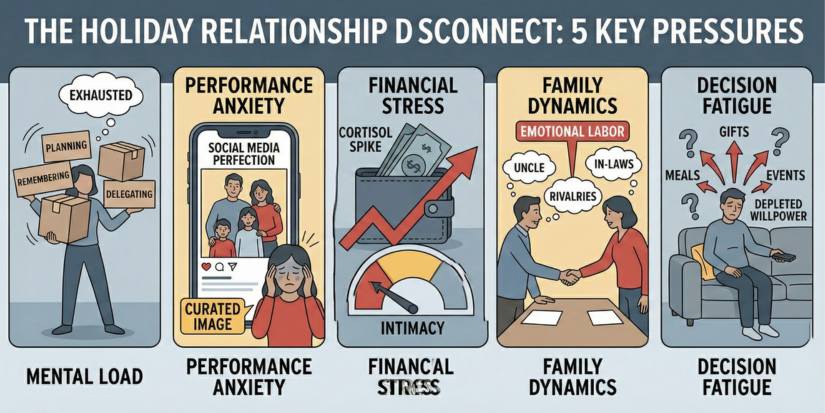
It's not your fault. Let me say that again. Feeling this disconnect isn’t a personal failure; it's a predictable reaction to an insane set of pressures. The "most wonderful time of the year" is practically engineered to push a relationship to its breaking point. Understanding the 'why' is the first step to fighting back.
Let's talk about the “mental load”—that endless, invisible list of tasks involved in making the holidays happen. It's the planning, the remembering, the anticipating, the delegating. And research consistently shows this burden falls disproportionately on women. One partner (usually her) becomes the default project manager for everything, which is an exhausting, thankless job. When you’re busy managing every single detail, it’s nearly impossible to also feel like a relaxed, romantic partner. Resentment is the natural byproduct of this imbalance.
Thanks to social media, we’re all drowning in images of perfect families in matching pajamas, flawless decorations, and gourmet holiday meals. This creates a subconscious pressure to perform, to curate a perfect experience for everyone else. All your creative and emotional energy gets funneled into this external performance, leaving absolutely nothing left for the internal health of your relationship. You’re so busy making things look good that you forget to make them feel good for the two of you.
Money is a massive source of tension, and the holidays throw gasoline on that fire. A recent survey from the American Psychological Association found that a staggering 88% of U.S. adults feel stress during the holidays, with finances being a primary trigger. This isn’t just mental; it’s physiological. Financial anxiety floods your system with cortisol, the stress hormone. Cortisol is the enemy of intimacy—it suppresses libido and shuts down your capacity for vulnerability. Romance feels like an unaffordable luxury when you’re worried about the January credit card bill.
When people feel the holiday stress affecting my relationship, finances are almost always a silent contributor. It’s hard to feel close when you’re secretly panicked about spending.
The holidays often mean navigating a minefield of complicated family relationships. You’re not just a couple; you're ambassadors, diplomats, and therapists, trying to manage your quirky uncle, your demanding mother-in-law, or old sibling rivalries. This emotional labor is draining. You spend the whole day presenting a united front and by the time you’re alone, you’re too exhausted to connect. You’ve used up all your goodwill on everyone else, with nothing left for each other.
And finally, there's simple decision fatigue. From Thanksgiving to New Year's, you make hundreds of tiny decisions: what to buy, where to go, what to cook, who to see. Our willpower is a finite resource, like a muscle that gets tired. After a day of flexing that muscle over and over, it’s completely depleted. It becomes infinitely easier to default to the path of least resistance—zoning out on the couch—than to make the active, effortful choice to engage with your partner.
Okay, so we know the problem. Now, what do we actually do about it? The answer isn't about finding more time; it’s about being fiercely intentional with the little time you have. You have to treat your relationship like the most important event on the calendar, because it is. This is the core of how to reconnect with your partner during the holidays.
This is non-negotiable. Every single day, you will schedule a 15-minute window where you are forbidden—I mean it, forbidden—from talking about to-do lists, budgets, or schedules. Set a timer if you have to. This is your sanctuary. Use this time to ask how your partner is feeling, share a ridiculous story about a coworker, or talk about a trip you want to take next summer. It’s about remembering there's a "you" and an "I" outside of this holiday chaos.
Spontaneity is a myth in December. Stop waiting for it. Instead, schedule tiny, simple "micro-dates." This isn't dinner and a movie; it's a 20-minute walk after dinner to look at the lights, a 10-minute coffee break on the porch before the kids wake up, or a deliberate "cocktail hour" at home for 15 minutes before you start making dinner. Putting it on the calendar makes it real. It signals that this time is just as important as that trip to the mall. These are some of the best romantic ideas for busy couples because they are achievable.
You need one thing this season that is sacred and belongs only to the two of you. This is your shield against the onslaught of family and social obligations. Maybe you exchange your personal gifts on the 23rd, just the two of you. Maybe you have a standing "pancakes and holiday music" breakfast every Sunday. It doesn't matter what it is, only that it is yours and yours alone. It’s a powerful way to reinforce your identity as a couple first.
Stop dividing and conquering everything. Yes, it’s efficient, but it’s also isolating. Pick one or two holiday tasks to deliberately do together. Put on some classic tunes, pour a glass of wine, and wrap gifts side-by-side. Make the holiday baking a team sport. Cook a meal together instead of having one person do everything. This reframes the work from a burden into a shared, bonding experience. You'll be amazed at the conversations that can happen while you’re both up to your elbows in cookie dough.
When you're feeling unseen, it's impossible to feel romantic. Make a conscious, active effort to notice and name your partner's contributions. Don't just say "thanks." Be specific. "I saw you took out the trash and the recycling without me asking—thank you, that was a huge help." Or, "You handled that awkward conversation with your aunt so well. I was really proud of you." This isn't just about being polite; it’s about making your partner feel seen and valued as a contributor, which kills the resentment monster before it can grow.
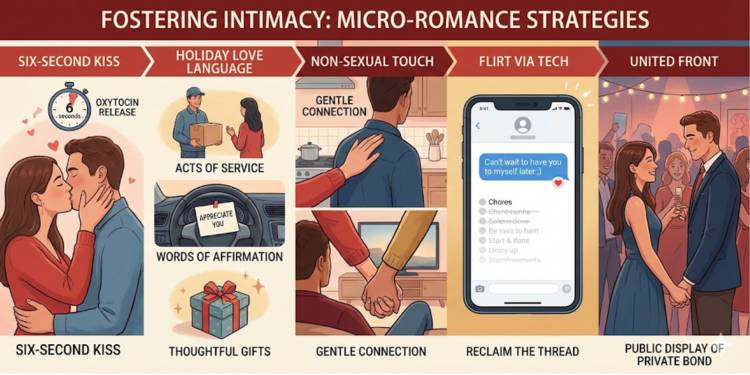
Grand gestures are off the table right now. That’s okay. Real, lasting intimacy is built in the tiny moments, not the big productions. This is the nitty-gritty of how to reconnect with your partner during the holidays, focusing on the small things that have a massive impact.
Relationship expert Dr. John Gottman pioneered this for a reason. Most couples kiss for a fleeting second, a perfunctory peck. A six-second kiss is a completely different animal. It's long enough to be mindful and present, and it's chemically proven to release oxytocin—the "bonding hormone." Make a rule: one six-second kiss when you leave in the morning and one when you see each other at night. It's a tiny investment that creates a real moment of connection.
You’ve heard of the five love languages. Now, give them a holiday spin. If their language is Acts of Service, secretly take a dreaded errand off their list, like standing in line at the post office. If it's Words of Affirmation, leave a note on their steering wheel telling them how much you appreciate them. For Receiving Gifts, buy them a small, thoughtful treat that has nothing to do with Christmas, just because you were thinking of them. It shows you see them, not just their role in the holiday machine. Thinking about these simple romantic ideas for busy couples can be a game-changer.
When you’re stressed, touch is often the first thing to go. Bring it back intentionally. Rest a hand on their back when you walk by them in the kitchen. Hold their hand for just a few minutes while you’re watching a show. Offer a quick five-second shoulder rub while they’re on their laptop. These small points of contact throughout the day keep the physical connection alive and signal care and closeness without any pressure.
Take a look at your text thread. Is it just a running log of grocery lists and ETA updates? Reclaim it for connection. Send a text during the day that has nothing to do with logistics. Send a picture that reminded you of a funny memory. Reference an inside joke. Or be a little flirtatious: "Can't wait to have you all to myself later tonight." It’s a simple way to keep the romantic energy simmering throughout the day.
Finally, present a united front when you’re out. This is you two against the world. At holiday parties, catch each other's eye across the room and share a smile. Bring your partner their favorite drink without being asked. In a conversation, mention something they did recently that you’re proud of. It’s a public display of your private bond, reinforcing to yourselves and to everyone else that you are a team. And feeling like a team is the complete opposite of feeling like roommates.
The holiday season's intense pressure often pushes couples into a "roommate phase," where connection is replaced by logistical coordination. This shift is marked by transactional conversations, a lack of casual affection, and solving problems as individuals rather than a team. The underlying causes are a blend of psychological and social pressures, including the immense mental load of planning, financial strain, and the fatigue from navigating family dynamics.
To counteract this, the focus must be on intentional, small actions rather than grand gestures. The solution involves scheduling "micro-dates," forbidding logistical talk during specific times, and turning shared chores into bonding opportunities. Rebuilding intimacy happens through consistent, minor rituals like a daily six-second kiss, specific forms of appreciation, and using technology for flirtation instead of coordination. These strategies help couples actively choose partnership, ensuring their relationship not only survives the holidays but emerges stronger.
These suggestions are designed specifically for time-crunched parents because they redefine what "quality time" looks like. It's not about finding a two-hour block for a date night. The goal is to create high-impact moments of connection that fit into the five or ten minutes you already have. For instance, the "holiday logistics embargo" can happen for just ten minutes after the kids are in bed, providing a brief sanctuary to see each other as people, not just co-parents. You can also reframe existing tasks as points of connection. Instead of dividing chores, choose one to tackle as a team, like baking cookies with the kids, which merges a family activity with a shared goal.
The key is to capitalize on the micro-moments. A six-second kiss before one of you leaves for an errand, a genuine compliment about how they handled a toddler's tantrum, or holding hands for thirty seconds while watching television are all potent deposits into your relationship's emotional bank account. These actions require very little time but send a powerful message of priority and affection, fighting the feeling of being two ships passing in the night.
It's a common concern that one partner might be more aware of the disconnect than the other. If your partner is resistant, the best approach is to lead by example without making demands. Start with actions that are entirely within your control. You can initiate a six-second kiss, you can be the one to offer specific, verbal appreciation for their efforts, and you can send a flirty text during the day. These actions often create a positive feedback loop; when one person feels more seen and appreciated, they naturally begin to soften and reciprocate.
Frame the desire for connection around your own feelings, rather than presenting it as a problem that needs to be fixed. Instead of saying, "We have a problem and need to do these exercises," try something softer like, "With all the holiday chaos, I really miss you. I'd love to find a small way for us to connect, just for a few minutes each day." This phrasing is an invitation, not a criticism, and it can open the door for them to see these small efforts as a way to support you, which is a much more appealing proposition.
Absolutely not. This phase is a normal, cyclical rhythm in nearly all long-term relationships, especially during periods of intense external stress like the holidays. Perceiving it as a sign of failure adds unnecessary shame and pressure. A more accurate and helpful way to view it is as a dashboard light coming on in your car. It’s not a signal that the engine has exploded; it’s simply an indicator that the relationship needs a specific type of attention and maintenance. It’s a call for intentional nurturing.
The strongest couples are not those who never experience disconnection, but those who recognize it when it happens and have the tools to navigate their way back to each other. The holiday season, with its unique pressures, is a predictable trigger for this dynamic. By acknowledging that this is a common challenge rather than a unique personal failing, you can approach the situation with curiosity and teamwork instead of fear, transforming it from a potential crisis into an opportunity to strengthen your bond.
This feeling of exhaustion is completely valid, and the last thing your relationship needs is another item on the to-do list. The secret is to focus on connection that adds energy rather than consumes it. Prioritize the lowest-effort, highest-reward strategies. For example, non-sexual physical touch requires almost no mental energy but yields significant emotional benefits. Simply sitting next to each other on the couch and holding hands or offering a quick shoulder rub can foster closeness without the pressure of a deep conversation.
Similarly, the "logistics embargo" can be positioned as a moment of mutual rest, not a task. Schedule a "low-energy date" where the only goal is to share a quiet space, perhaps listening to music together for fifteen minutes with no expectation to talk. The six-second kiss is another perfect example of a low-effort habit that releases bonding hormones and creates connection. The goal is to move away from the idea that romance must be a grand, energy-intensive production and embrace small, restorative rituals that feel good.
Protecting your relationship during the holidays requires presenting a united front to the outside world. This starts with a private conversation between the two of you to decide on your priorities. Look at the calendar of events and invitations together and decide which are non-negotiable and which you can politely decline. This prevents one person from feeling like the designated "bad guy" for saying no. Once you are aligned, you can communicate your decisions to family as a team.
Use "we" language when setting a boundary. A simple phrase like, "Thank you so much for the invitation, but we've decided to take that evening for ourselves to recharge," is powerful. It’s polite, firm, and presents an unbreakable team. Another effective strategy is proactively scheduling "at-home" days on your calendar with no obligations. This allows you to honestly tell relatives, "We already have plans that day," reinforcing that your time as a couple is a legitimate, pre-planned commitment, just as important as any party.
Financial anxiety is a potent intimacy killer for clear physiological reasons. When you are worried about holiday spending, your body is in a state of chronic stress, leading to elevated levels of the hormone cortisol. This fight-or-flight response is fundamentally at odds with the feelings of safety, relaxation, and vulnerability required for genuine emotional and physical intimacy. As a survey from the American Psychological Association noted, finances are a primary holiday trigger for the 88% of adults who feel seasonal stress. It’s incredibly difficult to feel romantic when your mind is preoccupied with a growing credit card balance.
This is precisely why low-cost and no-cost connection strategies are so critical. A walk to look at neighborhood lights, a shared pot of tea after a long day, a deliberate 15-minute conversation, or a long hug cost nothing but yield enormous emotional returns. Focusing on these acts reminds you both that your connection is not dependent on expensive gifts or elaborate dates. It reinforces that the best thing you have is each other, which can be a powerful antidote to the anxiety created by financial pressures.