March 2, 2026

Apology Text to My Wife After I Yelled – 3 Real Versions That Help Apology Text to My Wife After I Yelled: 3 Versions That Actually […]



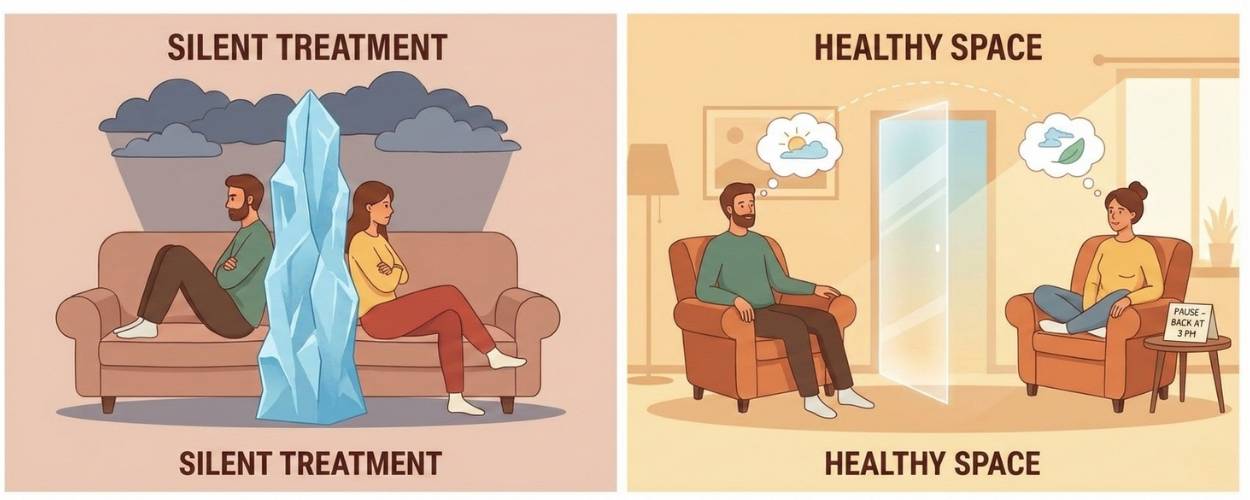
The air in the house is thick. It’s so heavy you can feel it pressing on your chest.
One minute you were arguing about something that feels so stupid now—dishes, plans, a tone of voice—and the next minute, a wall of silence went up. It’s a wall you can’t see, but you crash into it every time you walk into a room. Your partner is there, physically, but they look right through you. Every attempt at connection is met with a cold shoulder, a short answer, or nothing at all. The silence is deafening.
Your mind is racing, a frantic hamster on a wheel. What did I say? Is it really that bad? You start to question your own reality, replaying the argument over and over, trying to pinpoint the exact moment you messed up. You’re desperate and confused, and you just don't know what to do when your partner gives you the silent treatment. Should you apologize again? Should you give them more time? It feels like walking on a minefield, where any step could make things a hundred times worse. The anxiety is just brutal.

Let me just say, if you're feeling this way, you're not crazy. That feeling of rejection and confusion is a deeply human response to being iced out. It’s a special kind of awful. I’ve been there, and I’ve coached countless people who feel trapped in this exact cycle. One of the biggest relationship game-changers I’ve ever seen is when a couple finally learns the difference between silent treatment and taking space. Because one is a weapon designed to punish you, and the other is a tool used to protect the relationship. They are worlds apart.
On the flip side, maybe you're the one who goes quiet. You get so flooded with anger or hurt that words feel impossible. The thought of continuing the fight makes your skin crawl, and you just need to get away to breathe. But you have no idea how to ask for space in a relationship without hurting feelings, so you just… shut down. You don’t mean to be cruel, but you see the hurt in your partner’s eyes, and you know this isn’t working either. You feel stuck, too.
So let’s cut to the chase. The purpose of this article is to give you a rock-solid framework for telling these two behaviors apart, for good. We're going to get crystal clear on what constitutes a healthy, respectful pause versus what veers into toxic territory. Recognizing the subtle but powerful signs of silent treatment emotional abuse is the first step toward breaking the cycle. This isn't just about feeling better in the moment; it's about building a foundation of trust where you both feel safe, even when you disagree.
Navigating this is tough, but you absolutely can. By the time you're done here, you’ll not only have a clear understanding, but you’ll also have a toolbox full of strategies. You’ll know what to do when your partner gives you the silent treatment to protect your own peace. And if you’re the one who needs a moment, you’ll have a script for how to ask for space in a relationship without hurting feelings. Understanding these patterns, especially the signs of silent treatment emotional abuse, empowers you to demand a healthier way of handling conflict. You deserve that.
Let’s be brutally honest about what the silent treatment really is. It isn’t a break. It’s not a timeout. It’s a power play, plain and simple. Think of it as weaponizing the absence of words. The core intention here is never to solve the problem or find common ground. No, the goal is to punish you, to make you feel so anxious and wrong-footed that you come crawling back, ready to concede anything just to make the silence stop. It’s about control.
Someone using this tactic is deliberately withholding communication to make you feel guilty, isolated, and desperate. They want you to marinate in your own anxiety. They are essentially putting you in an emotional solitary confinement until you break. It’s a passive-aggressive maneuver that allows them to inflict pain without having to say a single aggressive word. And that’s what makes it so insidious; they can always deny it, saying "I just didn't feel like talking." But you know, and they know, it’s much deeper than that.
You can feel the signs in your gut long before you can name them. It’s the way they pointedly ignore a direct question, looking at the TV as if you don't exist. It’s the monosyllabic answers—"fine," "yes," "no"—delivered with the warmth of a glacier. This is often paired with non-verbal cues meant to twist the knife: the dramatic sigh, the roll of the eyes, the way they physically turn their body away from you. They are communicating, alright. They’re communicating pure contempt without the accountability of words.
When this behavior becomes a pattern, we have to call it what it is: a form of emotional abuse. It’s a classic stonewalling technique, which the renowned relationship researcher Dr. John Gottman identified as one of his "Four Horsemen of the Apocalypse"—a key predictor of divorce. Stonewalling shuts down all possibility of repair. It creates a terrifying environment where you feel like your emotional survival depends on placating the other person's unspoken demands. It’s a slow-acting poison to intimacy and trust.
If you've ever felt that being ignored hurts physically, you're not imagining things. Groundbreaking research from neuroscientists like Dr. Naomi Eisenberger at UCLA has shown that social rejection and ostracism activate the anterior cingulate cortex—the very same part of the brain that registers physical pain. That gut-wrenching ache you feel? Your brain is processing it just like a broken arm. Let that sink in. The silent treatment isn't just "in your head"; it's a profound psychological and physiological assault.
Understanding the motivation doesn't excuse the behavior, but it can offer some clarity. Often, the person using the silent treatment has incredibly poor conflict-resolution skills, likely learned from their own family growing up. They may be terrified of direct confrontation and see silence as their only shield. For others, it’s about a deep-seated need for control, sometimes stemming from narcissistic traits. They can’t regulate their own big emotions, so they turn the tables and make you responsible for their internal chaos by punishing you into submission.

Now, let’s pivot completely and talk about something that can look similar on the surface but is fundamentally different in its soul: taking healthy space. This is not a weapon; it is a tool. It is the mature, respectful act of pausing a heated conversation before it goes off the rails. It’s one of the best things you can do for the long-term health of your relationship. I’ve seen it save marriages.
The entire purpose of taking a healthy pause is self-regulation. It’s a conscious choice to prevent further damage. The intent is restorative, not punitive. It’s someone saying, "I value this relationship too much to continue fighting while I’m this angry. I need to calm down so I can come back and actually hear you." It’s a move made out of respect for you and the partnership, a clear signal that they want to solve the problem, not win the fight.
Here is the absolute, non-negotiable difference: taking healthy space is announced. It is communicated clearly and kindly. The silent treatment is a unilateral action sprung on you without warning, leaving you in the dark. A healthy pause is a collaborative agreement, even if it’s a quick one. It’s the difference between someone vanishing into thin air and someone leaving a note on the counter that says, "Gone for a walk to cool off, back in an hour to talk. I love you."
This act of communication is everything. It removes the anxiety and replaces it with security. Simply stating the need for a break, providing reassurance, and—this is key—giving a specific timeframe for re-engaging transforms the dynamic. A perfect example is: "I'm feeling really overwhelmed and I'm afraid I'll say something I don't mean. I need about 30 minutes to myself. Can we please come back to this then?"
It sounds like ownership and responsibility. It sounds like "I" statements, not "you" accusations.
See the pattern? It’s clear. It’s respectful. It’s time-bound. This is the gold standard for how to ask for space in a relationship without hurting feelings.
When you’re in the thick of it, the lines can feel blurry. So let’s put these two behaviors under a microscope and compare them directly. Understanding the clear difference between silent treatment and taking space is your first line of defense.
The silent treatment is 100% punitive. Its goal is to make you suffer, to teach you a lesson, and to force you to change your behavior out of fear. It’s a power trip. Healthy space is restorative. Its goal is to prevent further emotional harm to both people, allowing for a calm-down period so the conflict can be resolved productively. One seeks to inflict pain, the other seeks to prevent it.
This is the brightest red line between them. The silent treatment is defined by its lack of communication. It’s an abrupt, unexplained withdrawal that creates a vacuum of confusion and anxiety. Healthy space, on the other hand, is a communication strategy. It uses words to create a temporary, agreed-upon pause with the explicit promise of returning. One is a void; the other is a plan.
With the silent treatment, you have no idea when it will end. The silence can last for hours, days, or even weeks. It ends only when the giver decides you’ve been punished enough or when they get what they want. It’s an emotional hostage situation. A healthy space is always time-bound. There is a clear, stated expectation of when the conversation will resume, which provides emotional safety for the person waiting.

Okay, let’s move from theory to practice. Knowing the difference is one thing; handling it in the moment is another beast entirely. Here’s your game plan.
If you’re the one who gets flooded and needs to step away, you have to learn a new script. The first step is recognizing your own body’s warning signs—the tight chest, the racing heart, the desire to just bolt. When you feel it, use a non-blaming "I" statement. The formula is simple: "I am feeling [emotion] and I need [specific amount of time] to [self-soothing activity]. I promise we will talk about this at [specific time]." Then, actually use that time to calm your nervous system, not to build your legal case against your partner. This is about de-escalation, not just reloading. Learning how to ask for space in a relationship without hurting feelings is a skill, and it takes practice, but it's a relationship-saver.
This is so tough, I know. Your first instinct might be to panic, apologize profusely, or get angry. Don't. Your first job is to regulate your own emotions. Take a few deep breaths. Remind yourself that this is a manipulation tactic and not a reflection of your worth. Gently and calmly, name the behavior. Use an "I" statement like, "I'm noticing you're not responding to me, and it makes me feel really hurt and alone. I can't solve this with you if you shut me out." Say it once. Do not beg or plead. This only feeds the power dynamic. Then, and this is critical, disengage. Go read a book, call a friend, work on a hobby. Do something that reaffirms your sense of self outside of their approval. The lesson here is that their silence will not control your emotional state. When you figure out what to do when your partner gives you the silent treatment, you take your power back. Once they resume communication, you must set a boundary: "I'm glad we're talking. In the future, that kind of silence isn't a healthy or acceptable way for us to handle disagreements. We need to find a better way." This is where you might suggest couples counseling if the pattern is deeply entrenched. You deserve better.
During relational conflict, a pause in communication can either be a destructive weapon or a constructive tool. The silent treatment is a punitive and controlling act intended to punish a partner, creating anxiety and emotional distress. It is characterized by an abrupt, unexplained withdrawal that lasts for an indefinite period. This behavior is a form of passive aggression linked to emotional abuse and stonewalling, a known predictor of relationship dissolution.
In direct contrast, taking healthy space is a restorative strategy for self-regulation and conflict de-escalation. Its effectiveness hinges on clear communication. A person taking healthy space verbally expresses their need for a break, provides reassurance, and establishes a specific timeframe for resuming the conversation. This proactive approach prevents further harm, builds trust, and fosters a safe environment where disagreements can be navigated constructively, strengthening the relationship's foundation rather than eroding it.
While a single instance of withdrawal might stem from feeling overwhelmed, a recurring pattern of using the silent treatment is widely recognized as a form of emotional abuse. The key lies in the intent and the systemic impact on the relationship. When silence is repeatedly used to punish, manipulate, and control a partner, it creates an environment of fear and instability. This behavior is synonymous with "stonewalling," which relationship expert Dr. John Gottman identifies as one of the four primary predictors of divorce. Abusive stonewalling shuts down all avenues for connection and repair, forcing one partner into a state of anxiety and desperation, which fundamentally corrodes intimacy and trust.
The critical difference between healthy space and the silent treatment is explicit communication. If your partner misinterprets your need for a break, it is essential to be clear and reassuring in your approach. Instead of simply withdrawing, you must announce your intention. Use "I" statements to take ownership of your feelings, such as, "I am feeling overwhelmed and need to calm down." Provide a specific, reasonable timeframe for your return, for example, "I'm going to take a 30-minute walk, and then we can talk." Reassure them of your commitment to resolving the issue. This transforms a potentially hurtful act into a collaborative strategy for protecting the relationship.
There isn't a universal rule for the maximum duration of a healthy pause, but its defining feature is that it is time-bound and mutually understood. A break of 20 minutes to a few hours is often sufficient for de-escalation and reflection. The problem arises when the space becomes indefinite, which mirrors the silent treatment. If a break needs to extend beyond a few hours, communication becomes even more vital. Sending a text to check in or reaffirming the plan to reconnect is crucial. A pause that lasts for days without any contact, even if initially announced, ceases to be a constructive tool and can create the same feelings of abandonment and anxiety as the silent treatment.
Someone may resort to the silent treatment without a conscious desire to be malicious; often, it is a learned and deeply ingrained coping mechanism. It can stem from a childhood where this behavior was modeled or from an intense fear of direct confrontation. They may feel so emotionally flooded that shutting down feels like their only option for survival. However, regardless of the underlying intention, the impact on the recipient and the relationship is undeniably damaging. It remains a destructive and manipulative tactic. Understanding that it comes from a place of poor emotional regulation does not excuse the behavior, but it highlights the need for the individual to learn healthier, more communicative strategies for managing conflict.
Recognizing a shared destructive pattern is the first step toward change. The path forward requires a mutual agreement to abandon this tactic and learn new skills. Both partners should commit to recognizing their personal triggers for emotional flooding. When one person feels overwhelmed, they must practice the script for taking healthy space: using an "I" statement, setting a clear timeframe, and offering reassurance. The other partner must commit to respecting this request and using the time to self-soothe as well. Breaking this cycle is challenging and may require the guidance of a couples counselor who can provide tools and facilitate a safer way to communicate during disagreements.
The profound pain experienced from being ignored is not an overreaction; it is a genuine neurological response. Research conducted by neuroscientists like Dr. Naomi Eisenberger has demonstrated that acts of social rejection and ostracism, such as the silent treatment, activate the dorsal anterior cingulate cortex. This is the same region of the brain that processes the distressing component of physical pain. In essence, your brain interprets the emotional agony of being shut out in a similar way it would interpret a physical injury, like a burn or a broken bone. This scientific finding validates the intense, gut-wrenching feeling that accompanies the silent treatment, confirming it as a significant psychological and physiological event.
This article provides a comprehensive guide to differentiating between the silent treatment and taking healthy space during relationship conflicts. It defines the silent treatment as a punitive, controlling form of emotional abuse (stonewalling) intended to punish a partner, characterized by an indefinite and unexplained withdrawal. In contrast, healthy space is presented as a constructive tool for de-escalation that relies on clear communication, including stating the need for a break, providing reassurance, and setting a specific time to resume the conversation. The article offers actionable strategies for both individuals who need space and those who are subjected to the silent treatment, aiming to replace a destructive cycle with a foundation of trust and safety.
how to respond when your partner stonewalls you, communication skills for couples during conflict, setting boundaries with a passive-aggressive partner, difference between needing space and emotional abuse