March 2, 2026

Apology Text to My Wife After I Yelled – 3 Real Versions That Help Apology Text to My Wife After I Yelled: 3 Versions That Actually […]




There’s a strange and painful irony to January, isn't there? It’s supposed to be all about fresh starts. A clean slate. New gym memberships and optimistic resolutions. But for countless couples, the promise of a new year brings a devastating ending. If you’ve ever felt a quiet dread as the holiday decorations come down, you’re not imagining things. Lawyers and therapists have known it for years: January is, unofficially, "Divorce Month." The phone calls to law offices surge, and couples who just posed for smiling holiday photos find themselves asking, "How did we get here?" And maybe you’re asking that same question right now.
You just survived the gauntlet. Weeks of forced family fun, stretched budgets, and the crushing weight of trying to make everything "perfect." So many of us hold our breath through November and December, pinning our hopes on one magical Christmas morning to fix the cracks that have been forming all year. This intense holiday pressure affecting relationships creates a pressure-cooker environment. When the manufactured cheer fails to magically heal deep-seated issues, the disappointment that follows can feel like the final straw. It’s the silence after the storm that becomes deafening, leaving you to face the reality that the tinsel and lights were just hiding a much bigger problem.
But what if this year could be different? What if, instead of just bracing for impact, you had a real game plan? I want to be clear: this isn't just another article full of depressing statistics. My goal is to give you hope and, more importantly, a toolkit. We’re going to get into the nitty-gritty of why this January phenomenon happens—the psychology, the financial triggers, all of it. But then, we’re going to pivot to what really matters: actionable, proven strategies to prevent divorce after the holidays that you can start using today. This is about learning how to fireproof your marriage from stress in a way that feels authentic and manageable.
This isn’t about grand, impossible gestures. It’s about understanding the small, consistent actions that build a resilient and deeply connected partnership. Forget the vague resolution to "be a better spouse." We will break down what that actually looks like day-to-day. You’ll learn the core communication skills and emotional habits that relationship experts like Dr. John Gottman have proven to be the bedrock of happy, lasting marriages. Think of these as the real strategies to prevent divorce after the holidays—the ones that build a foundation so strong that the seasonal holiday pressure affecting relationships can’t shake it. This guide is your first step in learning how to fireproof your marriage from stress for good.
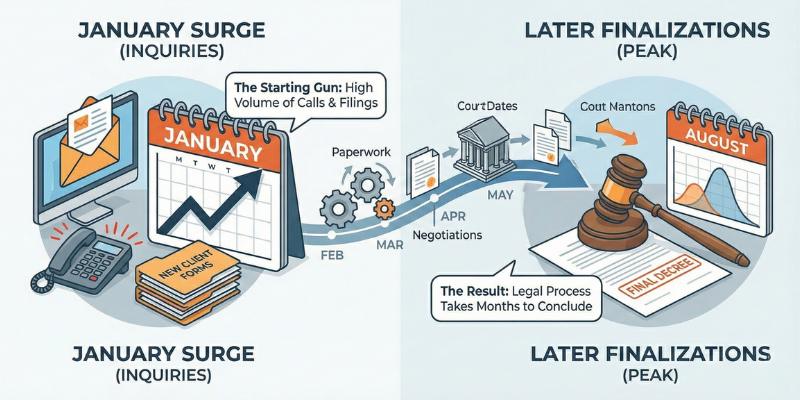
First things first, let’s be clear: "Divorce Month" isn't some myth cooked up by the media. Ask any family law attorney, and they'll tell you their phones start ringing off the hook the first week back after New Year's. It's the busiest time of their year for new client inquiries. While the actual divorce decrees might be finalized in March or August, January is when the process kicks into high gear. It’s the starting gun for the end of a marriage.
This isn't just anecdotal, either. Researchers at the University of Washington crunched the numbers back in 2016 and found definitive, biannual spikes in divorce filings, with the most significant one occurring right after the winter holidays. This study gave hard data to what legal professionals had observed for decades. They saw that our cultural rhythms—our shared holidays and vacations—directly impact one of the most personal decisions a person can make.
You might be surprised to learn this trend isn’t uniquely American. It’s a pattern seen across the Western world, from the U.K. to Canada. This tells us something profound about the shared cultural pressures we all face. The expectation to create a "perfect" holiday season is a universal burden, and it seems the fallout is just as widespread. It’s a testament to how these external forces can rock the foundations of our most intimate relationships.
An important distinction to make is between someone picking up the phone to call a lawyer and the day the divorce is legally final. The January surge is all about that first step—the inquiry, the consultation, the initial filing. The legal system, as you can imagine, doesn't move at lightning speed. The paperwork, negotiations, and court dates mean that the wave of January filings often results in a statistical peak of finalized divorces a few months down the road.
So, what is it about that stretch from Thanksgiving to New Year's that acts as a final catalyst for so many struggling couples? In my experience, it often boils down to one powerful and painful emotion: hope. Many people look at the holiday season as a last-ditch effort, a final chance for the "magic" of the season to fix what's broken. They think, "If we can just have one perfect Christmas, maybe we can find our way back."
This hope is a heavy burden to place on a few festive weeks. When that magical fix doesn't happen—when the same old arguments resurface over turkey, or the silence between you feels even colder next to a twinkling tree—the disappointment is crushing. It confirms the fear that if even the holidays can't save you, then nothing can. This failed hope becomes the final piece of evidence needed to make a life-altering decision.
Let's be honest, even the happiest couples can get on each other's nerves after too much time together.For a relationship already under strain, the extended, forced togetherness of the holidays can be absolute torture. There's no escape to the office or separate routines. Every little annoyance, every unresolved issue, is magnified. The very thing that's supposed to bring you closer—uninterrupted time together—ends up highlighting the painful distance that already exists between you.
The turn of the calendar page holds immense psychological power. It’s a culturally ingrained moment for a "fresh start." We promise ourselves we'll eat better, exercise more, and finally eliminate the things that make us unhappy. For someone in a painful marriage, the logic becomes brutally simple: if my biggest source of unhappiness is my relationship, then my New Year's resolution must be to end it. It feels like taking control, a definitive step toward a better future.
The constant barrage of picture-perfect families on social media during this time makes everything worse. You scroll through feeds filled with matching pajamas, joyous gatherings, and declarations of love. If your own reality is one of tension and unhappiness, that gap between the ideal and your real life can feel like a chasm. The intense holiday pressure affecting relationships becomes a constant, painful reminder of what you don't have, leading to profound disillusionment.
Financial worries and emotional exhaustion pile on top of all this. The stress of buying gifts, planning events, and navigating complex family dynamics drains your emotional bank account. When your reserves are low, your tolerance for your partner's flaws and your marital problems hits rock bottom. It's a perfect storm of emotional, social, and financial strain that can make January feel like the only way out.
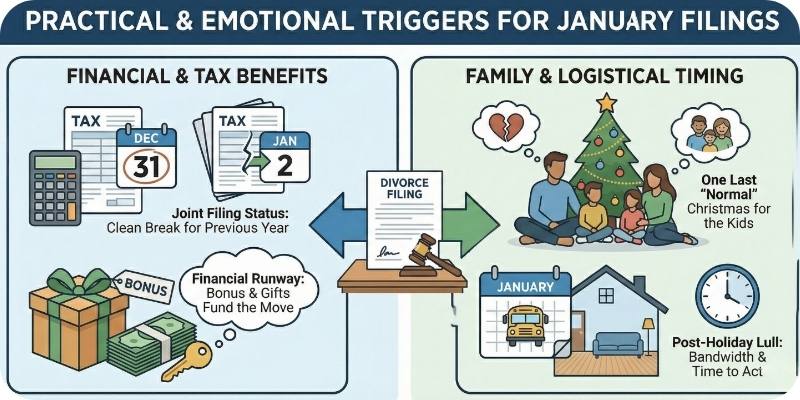
Beyond all the emotional turmoil, there are some very practical, almost cold, reasons why January is the logical time to pull the trigger. Ending a marriage is a complex legal and financial process, and timing can make a significant difference. Many couples, even in their anger and sadness, are pragmatic enough to wait for the most opportune moment.
One of the biggest drivers is taxes. Your marital status on December 31st determines your tax filing status for the entire year. Filing for divorce on January 2nd means you can still file your taxes jointly for the previous year, which often provides significant financial advantages. It’s a clean financial break, avoiding the headache of sorting out a mid-year split with the IRS. It may not sound romantic, but it’s a huge factor.
Holiday bonuses can also play a crucial role. Let’s face it, hiring a divorce attorney and securing a new place to live costs money—often, a lot of it. A year-end bonus or a generous cash gift from family can suddenly provide the financial runway needed to make the move. That money can feel like an "escape fund," making the daunting prospect of separation financially possible for the first time.
This is the one that breaks my heart every time I hear it, and I hear it a lot. So many parents will endure an unhappy holiday season for the sake of their children. They want to give them one last "normal" Christmas, one final memory of the family all together under one roof, before their world is turned upside down. It’s a selfless, painful act of love that pushes the inevitable off until the new year.
Finally, there’s the simple matter of bandwidth. Once the holiday chaos subsides, the kids are back in school, and work routines are re-established, there’s suddenly time. There is mental space to think clearly and logistical freedom to schedule those confidential appointments with attorneys. The post-holiday lull provides the quiet, practical window needed to start taking the necessary steps.
Alright, enough about the problem. Let's talk about the solution. Understanding why marriages crumble in January is one thing; learning how to build one that can withstand the heat is another entirely. This isn't about luck or finding the "perfect" person. It's about having the right tools and using them consistently. The most effective strategies to prevent divorce after the holidays are the ones you practice all year long.
I’m not just going to tell you to "talk more." You need to talk differently. Relationship researcher Dr. John Gottman suggests using a "soft start-up" for tough conversations. Instead of hitting your partner with an accusation like, "You never help with the kids!" you start softly. Try, "I'm feeling really overwhelmed with the kids' schedules. Could we talk about how to divide things up?" It's a game-changer.
To add to that, I urge you to schedule a weekly "State of the Union" meeting. Put it on the calendar. This is a calm, dedicated time—no phones, no TV—to talk about what's working, what's not, and how you're both feeling. It prevents resentment from building up until it explodes. This is a core component of how to fireproof your marriage from stress.
Dr. Gottman's research found a stunningly simple predictor of marital success: for every one negative interaction during a conflict, stable couples have at least five positive ones. A negative interaction is a criticism or moment of contempt. Positive interactions are the small, everyday things: a thank you, a quick hug, a shared laugh, or simply saying, "That's interesting," when your partner tells you about their day. This isn't about avoiding fights; it's about overwhelming the negative with a cushion of positivity.
Think about your day. How many times does your partner make a small "bid for connection?" It could be as simple as, "Wow, look at that bird," or, "I had the weirdest day at work." These are tiny moments where they are reaching out for your attention. You have a choice: you can "turn towards" them by engaging ("Oh cool, what kind is it?") or "turn away" by ignoring them or grunting. Consistently turning towards builds a massive emotional bank account that you can draw from when times get tough.
Conflict is inevitable, but according to Gottman, four behaviors are the kiss of death for a relationship: Criticism, Contempt (the worst of all), Defensiveness, and Stonewalling (shutting down). Learning to spot and stop these "Four Horsemen" is essential.
Instead of Criticism, use gentle "I" statements about your feelings. The antidote to Contempt is actively building a culture of appreciation. Counter Defensiveness by taking responsibility for even a small part of the problem. And when you feel yourself Stonewalling, ask for a 20-minute break to calm down—and promise to come back to the conversation. These are the most powerful strategies to prevent divorce after the holidays.
Finally, you have to be the fierce guardian of your connection. You must prioritize time for just the two of you, away from kids, work, and stress. Continue to date each other. Cultivate shared hobbies. Talk about your dreams. Realizing how to fireproof your marriage from stress means intentionally creating and protecting moments of joy, laughter, and intimacy. This is what refills your emotional reserves and reminds you why you chose each other in the first place. You have to build a future you're both excited to live in, together.
The term "Divorce Month" refers to the statistically significant spike in divorce inquiries and filings that occurs each January. This trend, supported by data from a 2016 University of Washington study, is not a myth but a predictable pattern driven by a combination of factors. The intense pressure of the holiday season often acts as a final stress test for strained relationships, magnifying existing conflicts through forced togetherness and the disappointment of a failed "last holiday" attempt at reconciliation.
Practical considerations also play a major role. Filing for divorce in January offers financial advantages, such as allowing couples to file taxes jointly for the previous year and utilizing holiday bonuses to cover legal fees. Beyond explaining this phenomenon, the core message is proactive. Couples can "fireproof" their marriage by implementing research-backed strategies from experts like Dr. John Gottman. These include mastering communication, maintaining a five-to-one ratio of positive to negative interactions, and learning to manage conflict constructively by avoiding destructive behaviors.
"Divorce Month" is a very real and well-documented phenomenon. It is not simply a media narrative or an anecdotal observation from legal professionals. The concept is substantiated by hard data, most notably from a 2016 study conducted by researchers at the University of Washington. They analyzed divorce filings over several years and identified distinct biannual peaks, with the most prominent surge occurring in the months following the winter holidays, particularly January and March. This research confirmed what family law attorneys have reported for decades: their phones ring most frequently with new client inquiries in the first weeks of the new year, marking the beginning of the legal process for many couples.
This pattern is not isolated to the United States; it has been observed in various other Western countries, indicating that it is tied to cultural rhythms surrounding major holidays. The January spike represents the initial step—the inquiries and first filings—which then leads to a subsequent peak in finalized divorces a few months later, typically around March. Therefore, while the term might sound informal, it accurately describes a predictable seasonal trend in the dissolution of marriages, rooted in a confluence of emotional, social, and practical triggers that converge at the start of the year.
Yes, the research that identified the post-holiday surge in January also uncovered a second, similar spike that occurs late in the summer, typically in August. The University of Washington study revealed these two distinct periods as the primary times when divorce filings peak throughout the year. The reasoning behind the August spike mirrors the January phenomenon, but it is tied to the rhythms of summer vacation rather than the winter holidays. Much like the forced togetherness of Christmas, summer holidays often involve extended family trips and a break from the normal routines of work and school, which can serve as a pressure cooker for relationships that are already struggling.
Couples may hold out hope that a family vacation will mend their issues or bring them closer together. When the trip instead highlights their disconnection or exacerbates existing conflicts, the disappointment can be the final impetus to separate. Similar to the post-holiday period, the end of summer also presents a logical starting point for change. As children prepare to return to school and regular schedules resume, individuals often feel they have the mental and logistical bandwidth to begin the difficult process of consulting with attorneys and initiating divorce proceedings before the fall season begins.
Based on the extensive research of Dr. John Gottman, the single most powerful predictor of divorce is contempt. Gottman identified four destructive communication patterns that he termed the "Four Horsemen of the Apocalypse": Criticism, Defensiveness, Stonewalling, and Contempt. While all four are damaging, he consistently found that contempt is the most corrosive and is the leading indicator that a relationship is in serious trouble. Contempt goes beyond simple criticism; it is a statement or action that comes from a place of moral superiority. It involves mocking, sarcasm, name-calling, eye-rolling, and disrespectful humor.
Contempt effectively communicates disgust and a complete lack of respect for one's partner. It signals that one person sees the other as beneath them, which is profoundly damaging to the foundation of a partnership. Unlike criticism, which attacks a specific behavior, contempt attacks a person's very sense of self. According to the provided text, the antidote to contempt is to actively build a culture of appreciation and respect within the relationship. By focusing on a partner's positive qualities and expressing gratitude and admiration, couples can counteract this destructive force and maintain a healthy, respectful bond.
The holiday season acts as a final trigger for divorce due to a powerful combination of psychological and social pressures that create a high-stakes environment for struggling relationships. A primary driver is what is described as the "last holiday hope." Many couples on the brink of separation view the festive season as a final test, hoping that the supposed magic of Christmas or the joy of family gatherings will repair their fractured connection. When these high expectations are not met and the same arguments and tensions persist, the resulting disappointment is profound, confirming their belief that the relationship is beyond saving.
Furthermore, the period involves extended and often inescapable time together. This "forced togetherness" magnifies every small annoyance and unresolved issue, removing the daily buffers of work and separate routines that normally keep conflict at bay. The pressure is intensified by social media, which presents an endless stream of idealized family photos, creating a painful gap between that cultural ideal and a couple's unhappy reality. This culminates with the "New Year, new me" mindset, where the start of a new year psychologically prompts people to eliminate major sources of unhappiness, with a failing marriage being the most obvious target.
Beyond the emotional fallout from the holidays, there are several compelling practical and financial incentives that make January the most logical time for many to initiate divorce proceedings. One of the most significant factors is related to taxes. A couple's marital status on the final day of the year, December 31st, determines their tax-filing status for that entire year. By waiting until January to file, they can legally file their taxes jointly for the complete previous year, a status which often results in considerable financial benefits and a simpler tax preparation process. This creates a clean financial break before the new tax year begins.
Another practical trigger is the influx of cash from year-end work bonuses or holiday gifts. The process of separating is expensive, requiring funds for attorney retainers, court fees, and the cost of setting up a new household. A holiday bonus can provide the necessary financial resources, or an "escape fund," that makes separation a viable option for someone who previously felt financially trapped. Finally, parents often consciously decide to wait until after the holidays to protect their children, aiming to provide them with one last experience of a "normal" family Christmas before introducing the disruption of a divorce.
The "5:1 ratio" is a key finding from the research of Dr. John Gottman, a leading expert on marital stability. Through decades of observing couples, he discovered that the true indicator of a happy, stable relationship wasn't whether couples fought, but how they interacted overall. He determined that for every one negative interaction during a conflict, successful couples maintain at least five positive interactions. This "magic ratio" highlights that a healthy relationship requires a substantial cushion of positivity to overwhelm the inevitable moments of negativity, disagreement, and frustration. It’s not about avoiding conflict, but about ensuring the emotional bank account is overwhelmingly positive.
A negative interaction can include criticism, expressing contempt, or being defensive. In contrast, positive interactions are often small, everyday moments of connection. These can be simple acts like expressing gratitude, giving a compliment, showing physical affection like a hug or a touch, sharing a moment of humor, or demonstrating active interest when your partner speaks. Consistently making these positive deposits builds goodwill and emotional reserves. When a conflict does arise, the relationship is resilient enough to handle the strain because it is founded on a deep well of mutual affection and respect. Practicing this is a core strategy for fireproofing a marriage.
This article explores the phenomenon of "Divorce Month," the January surge in divorce filings driven by post-holiday emotional fallout and practical financial considerations. It deconstructs the psychological pressures of the holidays—such as the "last holiday hope" and forced togetherness—and the logistical triggers like tax advantages and year-end bonuses that make January a logical time for separation. The core of the article provides a proactive guide to "fireproofing" a marriage, offering research-backed strategies from Dr. John Gottman. These actionable steps include mastering communication techniques, embracing the 5:1 ratio of positive to negative interactions, recognizing bids for connection, and constructively managing conflict by avoiding the "Four Horsemen." The piece concludes with a detailed FAQ section addressing common questions about the trend and its underlying causes.